


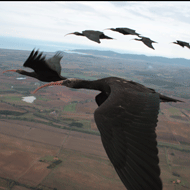
Scientists uncover complex flight strategy
While migrating birds flying in a V formation is a familiar sight to most, scientists have been unable to explain why, until now.
New research from the Royal Veterinary College (RVC) has revealed for the first time that birds fly in the optimal position and even time their wing beats for maximum aerodynamic advantage.
Lead researcher Dr Steven Portugal said: "The distinctive V-formation of bird flocks has long intrigued researchers and continues to attract both scientific and popular attention, however a definitive account of the aerodynamic implications of these formations has remained elusive until now."
Dr Portugal and colleagues attached tiny data loggers to a free-flying flock of northern bald ibises and followed in a microlight to measure their position, speed and heading, as well as every wing beat.
The specially developed GPS technology was custom-made at the RVC's Structure and Motion Laboratory and used to track 14 juvenile birds during 43 minutes of migratory flight.
Researchers found the birds timed their wing beats to make the most of the upward-moving air - known as "upwash" - created by the bird in front.
Additionally, the birds were found to fly in the optimal position to benefit from the upwash, avoiding the downwash - or "bad air" - which pushes them down.
Such a strategy was previously thought impossible due to the complexity of flight dynamics and sensory feedback that is necessary to achieve this.
Prior to this study, researchers say there has been insufficient data from free-flying birds due to the lack of devices to record and measure the precise aerodynamic interactions used by birds.
Dr Portugal said: "The intricate mechanisms involved in V formation flight indicate remarkable awareness and ability of birds to respond to the wingpath of nearby flock-mates. Birds in V formation seem to have developed complex phasing strategies to cope with the dynamic wakes produced by flapping wings."
Image courtesy of Markus Unsöld.


 Defra has published guidance for the vet sector ahead of a proposed UK-EU Sanitary and Phytosanitary agreement.



