


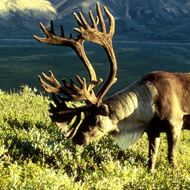
Study looks at how heavy grazing protects carbon sinks
Reindeer grazing could have an impact on climate change according to a new study.
Researchers from the University of Nottingham and The Arctic Centre of the University of Lapland, have looked at how reindeer grazing plays an important part in protecting carbon sinks — the planet’s natural carbon capture systems.
“We have shown that the amount of reindeer grazing of the tundra determines if more greenhouse gases will be release as the climate warms,” said Dr Sofie Sjögersten a lecturer in Environmental Sciences in the School of Biosciences at The University of Nottingham.
Carbon stored in tundra soils may be released to the atmosphere in a warmer climate, contributing to atmospheric carbon dioxide concentration, and intensifyiing global change.
But researchers found tundra with a long history of intensive grazing showed a weak response to climate warming.
They compared lightly and heavily grazed tundra in northern Norway.
Lightly grazed, dwarf-shrub-dominated tundra provided a stronger carbon sink than heavily grazed, graminoid-dominated tundra.
Warming however, decreased the carbon sink in lightly grazed tundra, but had no effect in heavily grazed tundra.
This is because in heavily grazed tundra, graminoids with rapid growth rates were able to increase their photosynthesis and carbon fixation under increased temperatures. A similar phenomenon did not occur in tundra under light grazing, where nutrient availability limits plant production.
The increased carbon fixation in heavily grazed tundra compensated against the warming-induced increase in the carbon dioxide release from the ecosystem.
“This works demonstrates the complexity of modelling ecosystem responses to climate warming. The interactions with other factors, grazing in our case, can be just as important as the direct effect of temperature rises and need to be considered in climate models,” said Neil Crout, Professor of Environmental Modelling in the School of Biosciences.
Academy Research Fellow, Sari Stark from the Arctic Centre, said: “Grazing alters several ecosystem properties, such as plant species composition and soil nutrient availability, which in turn alter ecosystem responses to climate warming.”
Image (C) Dean Biggins/Wikimedia


 Defra has published guidance for the vet sector ahead of a proposed UK-EU Sanitary and Phytosanitary agreement.



