
Your data on MRCVSonline
The nature of the services provided by Vision Media means that we might obtain certain information about you.
Please read our Data Protection and Privacy Policy for details.

In addition, (with your consent) some parts of our website may store a 'cookie' in your browser for the purposes of
functionality or performance monitoring.
Click here to manage your settings.
If you would like to forward this story on to a friend, simply fill in the form below and click send.

Your friend's email:
Your email:
Your name:
 
 
Send Cancel

First hard-bodied creatures named Cloudina
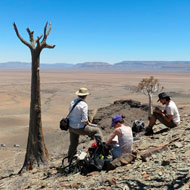
Reef in Namibia
The ancient reef is now located on dry land in Namibia.
Research dates ancient reef to 550 million years ago

A recent study, led by researchers at the University of Edinburgh, has revealed how one of the Earth’s oldest reefs was formed. 
 
The survivor of an ancient aquatic world, the reef is thought to have been built 550 million years ago by what are thought to be the first animals to have had hard shells, and is now located on dry land in Namibia.
 
A process called biomineralisation caused the development of hard, biological structures, allowing animals to fix to each other and to surfaces by producing natural cement.
 
This is thought to be a response to increasing selection pressures, as the reef allowed the tiny creatures to gain access to nutrient rich currents and living space, at a time when resources were scarce. 
 
The filter feeding organisms, known as Cloudina, lived on the seabed during the Ediacaran Period, which ended 541 million years ago. Prior to the emergence of Cloudina, animals had soft bodies.
 
Professor Rachel Wood of the University of Edinburgh’s School of GeoSciences, who led the study, said: “Modern reefs are major centres of biodiversity with sophisticated ecosystems. Animals like corals build reefs to defend against predators and competitors. We have found that animals were building reefs even before the evolution of complex animal life, suggesting that there must have been selective pressures in the Precambrian period that we have yet to understand.”
 
The research has been published in the journal Science, in collaboration with University College London and the Geological Survey of Namibia. It has been supported by the Natural Environment Research Council, University of Edinburgh and the Laidlaw Trust.
 
Image courtesy of Rachel Wood.

 

Become a member or log in to add this story to your CPD history

Submissions open for BSAVA Clinical Research Abstracts 2026

News Story 1
 The BSAVA has opened submissions for the BSAVA Clinical Research Abstracts 2026.

It is an opportunity for applicants to present new research on any veterinary subject, such as the preliminary results of a study, discussion of a new technique or a description of an interesting case.

They must be based on high-quality clinical research conducted in industry, practice or academia, and summarised in 250 words.

Applications are welcome from vets, vet nurses, practice managers, and students.

Submissions are open until 6 March 2026. 

Click here for more...
News Shorts
Survey seeks ruminant sector views on antimicrobial stewardship

A new survey is seeking views of people working in the UK ruminant sector on how to tackle the challenge of demonstrating responsible antibiotic stewardship.

Forming part of a wider, collaborative initiative, the results will help identify the types of data available so that challenges with data collection can be better understood and addressed.

Anyone working in the UK farming sector, including vets and farmers,is encouraged to complete the survey, which is available at app.onlinesurveys.jisc.ac.uk


