


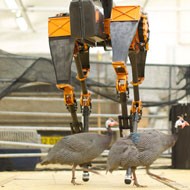
Study of bird movement may advance robot technology
Research into the running behaviour of guinea fowl could lead to improved prosthetic limbs, as well as advancements in the development of walking robots.
Guinea fowl are able to run at high speeds across complex terrains, almost instantly adjusting their gait, speed and step size. This makes them perfectly suited to their natural environment, which features sand, grassland, potholes and flat surfaces.
Researchers recreated this environment at the Royal Veterinary College (RVC) Structure and Motion Laboratory. It is hoped that analysis of the “swing-leg trajectory” may enable walking robots of the future to move at speed across uneven terrain.
Recent years have seen massive technological advances in robots, for example Honda's ASIMO and the US-funded ATLAS, unveiled last year.
While they are able to walk, run, negotiate stairs and even climb ropes, the art of running across complex terrain remains elusive.
Perfecting upright walking across any terrain type has long been one of the greatest challenges and ambitions for robotic engineers.
The research team, led by senior lecturer in locomotor biomechanics, hope to unlock the secret by studying guinea fowl movement.
Biped birds and humans have a similar gait while walking and running and use the same basic timing, motions and balance. This makes the study of birds such as guinea fowl valuable for improving prosthetic devices and walking robots.
Dr Daley said: “The guinea fowl are extremely agile and quick over uneven terrain, so the more we know about their movement dynamics, the more we can apply these principles to develop solutions for improved robotics and prosthetics.
“Current biped robotics can be slow and cumbersome and prosthetic limbs often don’t allow comfortable, natural gait over uneven terrain. But with further research and development, we could see may advances within the next few years, including improved prosthetic designs and other applications such as robots for disaster clean-up and, search and rescue in hazardous conditions.”
The study, Swing-leg trajectory of running guinea fowl suggests task-level priority of force regulation rather than disturbance rejection, has been published in the journal PloS ONE.
Image ©Alex Sproewitz, RVC


 Defra has published guidance for the vet sector ahead of a proposed UK-EU Sanitary and Phytosanitary agreement.



