


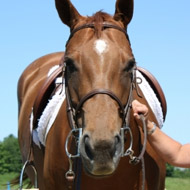
Study demonstrates how ears and eyes are important in horse communication
A study by the University of Sussex has discovered that horses use visual cues to work out what might be going on inside a stablemate's head. The study revealed that the direction of the horse's ears are one of the most important factors.
Mammal communication experts set up an experiment to discover which cues horses rely on to judge the direction of another horse's attention in a task where they had to choose where to feed.
Each horse was led to a point where it was released and allowed to choose between two buckets. On a wall behind the buckets, was a life-sized photograph of a horse's head facing either left or right.
The researchers discovered that if the ears or the eyes of the horse in the photograph were obscured, then the horse randomly chose from which bucket to eat. However, if the ears and eyes were visible, then the horse used the directional cues to guide their choice.
Previous work investigating communication of attention has focused on cues that humans use - body orientation, head orientation and eye gaze.
Lead researcher Jennifer Wathan says: "We found that in horses, their ear position was also a crucial visual signal. In fact, horses needed to see the detailed facial features of both eyes and ears before they would use another horse’s head direction to guide their choice"
Her colleague, Professor Karen McComb, added: "This study emphasises that animals other than primates are aware of subtle differences in facial expression and can use these to guide the decisions that they make. Fine scaled facial movements can indicate important changes in attention and emotional state and are likely to be crucial in determining social behaviour in a wide range of animals."
The paper, The eyes and ears are visual indicators of attention in domestic horses is published in Current Biology.


 Eligible members of BEVA will be able to vote for their Council team until Monday, 17 August 2026. Members will have received an election email on 17 July.



