


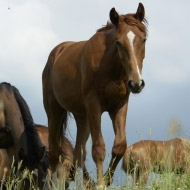
Study suggests that exercise may be an important factor in the origins of large colon impactions in horses.
A study investigating colic in the large colon has found that a surprisingly large number of horses in the UK were not ridden.
The research, led by the University of Nottingham, confirms evidence from previous research on history and management factors, but also raises new questions about the association between exercise and colic.
The aim of the University of Nottingham's Equine Colic Project is to develop guidelines to support horse owners and veterinary surgeons in decision-making in horses with colic. Colic is the most common emergency problem seen in the horse. Most cases are very mild and will resolve with treatment, however a small number of cases can be critical and require surgery or euthanasia. Deciding which cases are critical and how to diagnose them as quickly as possible is important for the welfare and best outcome for the horse.
The research team, consisting of Kyra Megan Jennings, Laila Curtis, John Harold Burford and Sarah Louise Freeman, based their research on reports from veterinary practitioners on their treatment of cases of colic in the large colon. The study is the first of its kind in the UK and provides the first evidence on how cases present and are initially assessed and treated by veterinary practitioners.
Just over 1000 colic cases were submitted by veterinary practitioners. Of these, 120 cases met the inclusion criteria for large colon impaction. The study found that 43 percent of these horses were not ridden, and 12.5 percent had a recent or current musculoskeletal injury.
The researchers say that the high proportion of cases that did not have ridden exercise has not been previously reported, and therefore warrants further investigation to determine whether this is a significant risk factor.
To read the full report, Prospective survey of veterinary practitioners’ primary assessment of equine colic: clinical features, diagnoses, and treatment of 120 cases of large colon impaction visit www.biomedcentral.com/1746-6148/10/S1/S2//


 Eligible members of BEVA will be able to vote for their Council team until Monday, 17 August 2026. Members will have received an election email on 17 July.



