


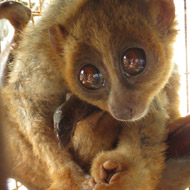
Loris named Kalo was seized after drugs raid in the Maldives
A Bengal slow loris is settling in to a new home at Monkey World's Ape Rescue Centre in Dorset after being confiscated during a drugs raid in the Maldive Islands earlier this year.
The loris named Kalo - meaning 'Buddy' in Maldivian - was seized during the raid in January and since then authorities have been trying to find a home for the animal without success until Monkey World came forward. At this stage it's not known if Kalo is a boy or a girl, as it's not easy to tell by just looking at them, but this should be confirmed shortly.
Transporting this protected species was also an issue but Dr Alison Cronin, Director of Monkey World, agreed to organise the paperwork, arrange the transport, and quarantine Kalo at the Dorset rescue centre. On August 14 the rescue operation took place thanks to British Airways who came to Kalo’s aid and flew him and Dr Cronin more than 5,000 miles back to UK.
Dr Cronin said Kalo was settling in. “We wanted to save Kalo as he may have had to be put down if a suitable and legal home was not found for him. He has muscle wastage from living in a small bird cage since he was stolen from the wild and his coat is dirty and sparse. His condition should improve dramatically in the coming weeks as he is climbing around his new home and eating loads of crickets and locusts."
Where Kalo was originally smuggled from remains a mystery as his former drug-smuggling owner refused to give any information about the loris. He could have come from several different countries in Asia as the species is native to north-east India, Bangladesh, Cambodia, Laos, Burma, Vietnam, southern China and Thailand.
The Bengal slow loris is nocturnal and has large round eyes for good night vision but throughout its geographic range they are in serious decline, threatened by growing demand from the exotic pet trade and for use in traditional medicine. They are also hunted by poachers for food and suffer from habitat loss due to illegal logging.
Image (C) Monkey World – Ape Rescue Centre.


 Defra has published guidance for the vet sector ahead of a proposed UK-EU Sanitary and Phytosanitary agreement.



