


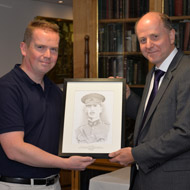
The first veterinary surgeon to be killed in the First World War has been honoured with a portrait
The first member of the RCVS to be killed in the First World War has been commemorated with a portrait at the college's offices in Belgravia House, a century after his death.
The portrait of Lieutenant Vincent Fox, who was an alumnus of the then Royal Veterinary College in Dublin, was presented by his great grand-nephew, James Tierney, and received by RCVS registrar Gordon Hockey.
Lieutenant Fox was killed in action on August 26, 1914 during the Battle of Le Cateau in northern France. He was a member of the former Army Veterinary Corps (AVC) and "in the absence of the Royal Army Medical Corps, was ordered to take charge of the medical treatment of the men using his skills as a veterinary surgeon."
He is buried in the nearby Commonwealth War Grave Cemetery at Caudry.
Sixty-seven veterinary surgeons are believed to have been killed in the First World War. Thirty-four are believed to have died from disease and 24 as a result of wounds. Nine are thought to have been killed in action.
Dr Paul Watkins, a veterinary surgeon and military historian who conducted the research into Lieutenant Fox said: “The AVC made very significant contributions to the war effort because there were so many horses and mules deployed. They would have been responsible for a range of tasks from husbandry – and educating other soldiers on husbandry – to the treatment of injured animals.”
On presenting the portrait, James Tierney said: “I am very pleased that the RCVS has accepted this portrait as future generations of vets will be able to see it here and learn about my great grand-uncle’s story."
Gordon Hockey, RCVS registrar, added: “We are very pleased to receive this portrait of Lieutenant Fox in recognition of the sacrifice he made during the First World War. The fact that he died while tending to his wounded fellow soldiers demonstrates the caring nature of the profession and the wider contribution to society made by veterinary surgeons.
“In this centenary year I would also like to commend the contribution made by members of the profession as a whole during the war.”
During the centenary celebrations, the RCVS Knowledge Library blog will be updated with stories about veterinary surgeons in the First World War. For updates visit www.rcvsknowledgelibraryblog.org.


 Defra has published guidance for the vet sector ahead of a proposed UK-EU Sanitary and Phytosanitary agreement.



