


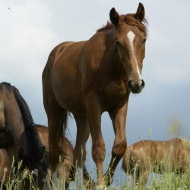
Three-thousand horse and pony owners are needed to participate in the fight against laminitis
More than 3,000 horse and pony owners are required to collaborate on a new web-based research project that aims to help all owners reduce the threat posed by equine laminitis.
Named "CARE" (Creating Awareness and Reporting Evidence), the four-year study is being undertaken by the Animal Health Trust (AHT) and the Royal Veterinary College (RVC) with funding from World Horse Welfare. It is being conducted by PhD student, Danica (Dee) Pollard, who is based at the AHT. The study will examine management factors which could contribute to the development of laminitis in British horses and ponies.
Dee said: "This is an exciting opportunity for equine owners in Britain to actively take part in scientific research and contribute towards a study that seeks to improve the health and welfare of British equines...each and every horse and pony is an eligible candidate and can join the study, regardless of past or present health status.”
The CARE study builds upon research which has already been conducted by Dr Claire Wylie.
Dr Wylie's study, also funded by World Horse Welfare, found that laminitis risk was increased by weight gain, increasing time since last deworming, box rest in the previous week and new access to grass in the past month. Her study also found that other factors such as the feeding of supplements and transport were associated with reduced laminitis occurrence.
Through the dedicated website, Dee Pollard and her team aim to recruit more than 3,000 horse and pony owners throughout Britain, so as to obtain a typical sample of the population and to apply the results to real-life situations.
Dr Kristien Verheyen, senior lecturer in clinical epidemiology at the RVC, said: “This is a fantastic opportunity for horse and pony owners to be at the forefront of equine research and actively contribute to a collective ‘team effort’ to reduce the serious welfare consequences that laminitis has on our animals."
Roly Owers, chief executive at World Horse Welfare, said: “Laminitis is a devastating disease of equines that causes massive welfare issues all year round. This is why World Horse Welfare is continuing to invest in vital research to better our understanding of the contributing factors to laminitis and the recurrence of clinical signs."
Horse owners interested in taking part in the research project can register at www.careaboutlaminitis.org.uk, or for more information email danica.pollard@aht.org.uk.


 Eligible members of BEVA will be able to vote for their Council team until Monday, 17 August 2026. Members will have received an election email on 17 July.



