


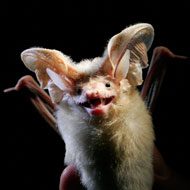
Echolocation behaviour may be more flexible than previously thought
Bats may be more flexible in their mode of foraging than previously thought, according to scientists from the University of Bristol.
Echolocating bats, that locate objects by reflected sounds, have historically been classified as being either "loud aerial hawkers" - that catch airborne prey - or "whispering gleaners" - that pick up prey from the ground.
A team of researchers led by Talya Hackett studied the foraging behaviour of desert long-eared bats, which are said to be a whispering gleaner, picking up ground-dwelling insects, such as scorpions, from the desert floor.
Bats were studied at four foraging and drinking sites in the Arava and Judean deserts in Israel. Researchers found that they not only changed their mode of foraging, but also their call and flight behaviour, suggesting their echolocation behaviour is more flexible than previously thought.
When gleaning, scientists say bats usually give a call of around 75 decibels (akin to a car engine). However, during this study researchers found the bats gave an average call of 119 decibels, similar to a 747 jet during take-off.
Furthermore, analysis of the bats' faeces revealed their diet included flying insects, such as flies, moths and beetles. This suggests the bats switched from gleaning to catching airborne prey.
Dr Hackett commented: "Although whispering bats have been known to opportunistically catch insects on the wing, this doesn't appear to be the case here. All the bats' calls we recorded were loud and we didn't observe any low flying search tactics which suggests that the bats were exclusively aerial hawking."
The findings raise the question: why would bats that are specially adapted to one foraging mode, choose to adopt another?
Co-author Dr Marc Holderied explained: "Changes in environmental conditions or prey availability could explain this change in the bats' behaviour. We studied them towards the end of an exceptionally hot and dry summer so it's likely the usual prey animals were scarcer: desert scorpions, for example, become more inactive during dry conditions.
"As a result, the bats might have entered different habitats with artificial irrigation or attacked different prey, adopting a different foraging mode when their typical prey was scarce."
The full study has been published in the Journal of Experimental Biology: http://jeb.biologists.org/content/217/17/3028.full
Image: CC BY-SA 3.0, Charlotte Roemer


 Defra has published guidance for the vet sector ahead of a proposed UK-EU Sanitary and Phytosanitary agreement.



