


California blue whale population rebounds
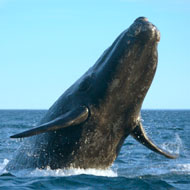
Today California blue whales number about 2,200.
The number of California blue whales has rebounded to near historic levels - the only known population of the species to have recovered from the effects of whaling - according to new research by the University of Washington.
Blue whales are the largest animals on earth - measuring nearly 100ft in length and weighing 190 tons as adults - but they have been hunted to near extinction levels in many areas.
California blue whales, also known as eastern North Pacific blue whales, are at their most visible while at feeding grounds 20 to 30 miles off the California coast, but are actually found along the eastern side of the Pacific Ocean from the equator up into the Gulf of Alaska. Today they number about 2,200, according to monitoring by other research groups. That’s likely to be 97 per cent of the historical level according to the model used by the authors of the new research - University of Washington doctoral student in quantitative ecology and resource management Cole Monnahan, assistant professor of aquatic and fishery sciences Trevor Branch and professor of aquatic and fisheries sciences Andre Punt.
They used figures from Russian whaling archives and used acoustic calls produced by the whales to separate - for the first time - the catches taken from the eastern Pacific along the American coast from those taken in the western Northern pacific near Japan and Russia - generally accepted to be different populations.
While 2,200 may seem to be a surprisingly low number of whales it's not when considering how many California blue whales were caught - approximately 3,400 between 1905 and 1971.
“Considering the 3,400 caught in comparison to the 346,000 caught near Antarctica gives an idea how much smaller the population of California blue whales was likely to have been,” said assistant professor Branch.
Lead author Cole Monnahan said the recovery demonstrated the ability of populations to rebuild under careful management and conservation measures.
“Our findings aren’t meant to deprive California blue whales of protections that they need going forward. The whales are recovering because we took actions to stop catches and start monitoring. If we hadn’t, the population might have been pushed to near extinction – an unfortunate fate suffered by other blue whale populations. It’s a conservation success story.”
For more information visit www.washington.edu/news/2014/09/05/california-blue-whales-rebound-from-whaling-first-of-their-kin-to-do-so


 Defra has published guidance for the vet sector ahead of a proposed UK-EU Sanitary and Phytosanitary agreement.



