


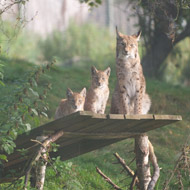
Cubs are quickly becoming favourites with visitors to the Highland Wildlife Park
Staff at Highland Wildlife Park, Kincraig, are celebrating after the birth of two northern lynx cubs.
The felines, which are just over three months old, are already firm favourites with visitors to the park. The cubs can often be seen climbing trees, exploring their enclosure and even practicing their pouncing at feeding time.
Born to parents Dimma and Switch on May 24, 2014 the cubs are the couple's third set of twins in consecutive years.
Douglas Richards, head of living collections for Highland Wildlife Park, said: "We were delighted when the cubs tumbled down to the front of their enclosure to join the rest of the family at feeding time the other day. They put on quite the show and even started copying mum and pouncing on their food – exactly how they would learn hunting techniques in the wild. It is always especially rewarding watching our young animals develop their natural behaviours.”
“The cubs have already been on quite an adventure, as mother Dimma has moved them to three different areas of the enclosure throughout summer! Dimma likes to give birth in the bushes at the front of the exhibit, so keepers roped off this area when she began to prepare for the birth. The ropes stayed up for around one month, until mum moved the cubs into the shed at the side of the enclosure; she moved them again to the secluded area at the rear which is where they still go for rest. Moving the cubs around the enclosure is a common behavioural characteristic of carnivores which they undertake as a measure of security.”
Northern lynx mate in late February to early March and usually have two or three kittens which stay with their mother until next breeding season. Their tail is short and thick with a blunt black tip. They also have distinctive dark tufts on their ears, which are thought to act a bit like antennae in helping to locate prey.
Lynx at Highland Wildlife Park are part of the European Zoo Association's coordinated breeding programme. Although the species is not endangered, it has become locally extinct in many areas of Europe, resulting in some sub-populations being considered as endangered or even critically endangered. Reduced prey availability, loss of habitat and illegal hunting are the biggest threats to wild lynx populations. There have been several successful lynx reintroduction projects within Europe, including in France and Switzerland.
Image (C) Alex Riddell


 Defra has published guidance for the vet sector ahead of a proposed UK-EU Sanitary and Phytosanitary agreement.



