


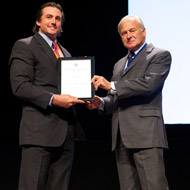
Awards recognise significant contributions made by veterinary surgeons to horse welfare
The outstanding achievements of four contributors to equine health and welfare were honoured with this year's prestigious BEVA awards.
The awards, formally presented at the BEVA Congress on Thursday 11 September, were established to reflect BEVA's recognition of and support for significant accomplishments by equine vets. The awards also honour others who are involved in horse health and welfare.
The BEVA Equine Welfare Award was presented to her HRH Princess Anne who is currently President or Patron of a large number of equestrian organisations and charities. Her direct impact on equine welfare is illustrated by her leading role in the establishment of the National Equine Welfare Protocol in the wake of the Amersham welfare case in 2008.
The BEVA Richard Hartley Clinical award was presented to Dr. Stephanie J Valberg, professor and director of the University of Minnesota Equine Centre for her paper Pasture myopathy/atypical myopathy in North America associated with ingestion of hypoglycin A within seeds of the box elder tree. The award, which is presented for evidence-based papers, is intended to support travel of the senior author and/or co-authors.
Dr. Weston Davis from Palm Beach Equine Clinic took the BEVA Trust Peter Rossdale Equine Veterinary Journal (EVJ) Open Award. The award is given for the paper that best achieved the EVJ's mission to publish articles which either improve or influence clinical practice and/or add significantly to the scientific knowledge that underpins and supports equine veterinary medicine. Dr. Davis' paper, Return to use and performance following exploratory celiotomy for colic in horses: 195 cases (2003–2010), was first published online in July 2012, and then March 2013 in Volume 45 of the Equine Veterinary Journal.
Other awards presented on the night include the Voorjaarsagen and BEVA Awards, which were introduced in 2005 to mark the close relationship between the two associations and is open to all those presenting a clinical research paper.
Dr. Ignacio Lizarrage of Ross University, St Kitts, West Indies took this year's BEVA Award for his paper Sedation and mechanical hypoalgesia induced by four different dosages of butorphanol in xylazine-premedicated donkeys.
The winner of the Voorjaarsdagen award will be selected from those presenting a clinical research paper at this year's BEVA Congress.
Image (C) BEVA


 Eligible members of BEVA will be able to vote for their Council team until Monday, 17 August 2026. Members will have received an election email on 17 July.



