


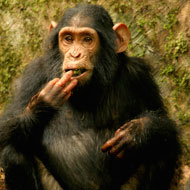
Scientists document social learning in wild populations for the first time
For the first time, scientists have observed a colony of wild chimpanzees adopting new feeding methods and transmitting them from individual to individual.
Researchers saw two novel feeding methods spread among the Sonso chimpanzee colony in Uganda's Bodongo Forest. These methods were the re-use of "leaf sponges", which are a tool used for drinking, and "moss sponging", a novel variation of the leaf sponge made from moss and leaves.
The findings were described as "extraordinarily rare" by Dr Catherine Hobaiter, lead researcher and psychology lecturer at the University of St Andrews.
While past research has been carried out in captive chimp populations, this is the first time scientists have observed how new behaviours are passed from one individual to another in a wild community. The research has been published in the journal PLOS Biology.
"We were incredibly lucky to be in the right place at the right time to document the appearance and spread of two novel tool-use behaviours," Dr Hobaiter added.
Leaf-sponging is a common behaviour in chimps that involves folding and chewing on leaves before dipping them into water to drink. During the six days researchers continually observed the chimps, a 29-year-old alpha male made a moss sponge from a combination of leaves and moss for the first time, while a dominant adult female watched.
Following this, the waterhole was visited regularly and seven other chimps were seen making moss sponges. All but one had seen the behaviour performed by another chimp prior to making a moss sponge themselves. The exception may have learnt the behaviour by re-using a left over moss sponge.
Scientists also observed a 12-year-old sub-adult male re-use a leaf sponge. After this, eight other chimps were seen to re-use sponges, but only four of these had seen the behaviour being carried out, suggesting social learning is less important for this behaviour.
Dr Hobaiter said: "Researchers have been fascinated for decades by the differences in behaviour between chimpanzee communities; some use tools some don’t, some use different tools for the same job.
"These behaviours have been described as ‘cultural’, which in human terms would mean they spread when one individual learns from another; but in most cases they’re long established and it’s hard to know how they originally spread within a group."
The research paper can be found here: http://www.plosbiology.org/article/info:doi/10.1371/journal.pbio.1001960
Image © Dr Catherine Hobaiter, University of St Andrews


 Defra has published guidance for the vet sector ahead of a proposed UK-EU Sanitary and Phytosanitary agreement.



