
Your data on MRCVSonline
The nature of the services provided by Vision Media means that we might obtain certain information about you.
Please read our Data Protection and Privacy Policy for details.

In addition, (with your consent) some parts of our website may store a 'cookie' in your browser for the purposes of
functionality or performance monitoring.
Click here to manage your settings.
If you would like to forward this story on to a friend, simply fill in the form below and click send.

Your friend's email:
Your email:
Your name:
 
 
Send Cancel

Emu eggs could shed light on human birth defects
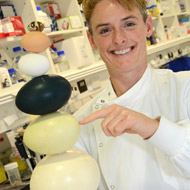
Dr Megan Davey with eggs
"Studying different types of birds gives us a deeper understanding of how our genes build bodies.”

Research may even hold clues to the causes of cancer

Emu and chicken eggs are helping scientists at the University of Edinburgh understand how genes can go wrong and cause birth defects.

Researchers from the university's Roslin Institute say
their findings may even offer clues to the causes of cancer. The eggs are being used to investigate how genes control the way our bodies grow and develop.

Genetic mutations responsible for causing the formation of extra fingers in chickens are similar to those in humans, according to the findings. The condition, called polydactyly, is the most common defect in new-born babies.

The team have discovered that a single gene, called Sonic Hedgehog, is essential to ensuring that our fingers and toes develop in the correct places. This mechanism applies to all animals with digits, including birds.

By examining chickens with too many fingers and toes, researchers can figure out how the gene is controlled and what happens when it goes wrong.

Researchers also found that emus have just one finger because only a small part of the Sonic Hedeghog gene is active during development.

Because this gene has been linked to some cancers, understanding it better may offer hope for new treatments.

Dr Megan Davey from the Roslin Institute, said: “Chicken eggs have been used for years to investigate how embryos grow because they develop outside of the mother so it is easy to see what is going on. Rather than putting all our eggs in one basket, studying different types of birds gives us a deeper understanding of how our genes build bodies.”

The team will showcase their research at the Easter Bush Campus Open Day on Saturday, October 4 as part of the Midlothian Science Festival. 

Image (C) The Roslin Institute

Become a member or log in to add this story to your CPD history

Vets launch new podcast for pet owners

News Story 1
 Two independent vets have launched a podcast to help owners strengthen their bond with pets. Dr Maggie Roberts and Dr Vanessa Howie, who have worked in both veterinary practice and major charities, are keen to use their experience to enable people to give pets a better life.

The venture, called Vets Talking Pets, provides advice and information on a range of topics, including how to select a suitable pet, where to obtain them and how to get the best out of your vet. Maggie and Vanessa will also discuss sensitive subjects, including end-of-life care, raw food diets and the cost of veterinary care.

The podcast can be found on all the usual podcast sites, including Podbean, Apple, Amazon Music and YouTube. 

Click here for more...
News Shorts
VMD issues guidance on AVM-GSL packaging

The Veterinary Medicines Directorate (VMD) has shared advice on its requirements for medicines considered AVM-GSL.

The guidance explains the information that should be on the outer package, and sets out the typical maximum pack size for an AVM-GSL product. It also describes the user-friendly language, structure and phrases required on packaging and product leaflets.

AVM-GSL products do not require discussion between the purchaser and a veterinary professional. This means that clear product information is needed to support sales choices.

The information will be useful for submitting new products to the AVM-GSL category and lowering the distribution category of products from NFA-VPS to AVM-GSL.

The VMD's guidance can be accessed here.


