
Your data on MRCVSonline
The nature of the services provided by Vision Media means that we might obtain certain information about you.
Please read our Data Protection and Privacy Policy for details.

In addition, (with your consent) some parts of our website may store a 'cookie' in your browser for the purposes of
functionality or performance monitoring.
Click here to manage your settings.
If you would like to forward this story on to a friend, simply fill in the form below and click send.

Your friend's email:
Your email:
Your name:
 
 
Send Cancel

Rare breed pigs help endangered species
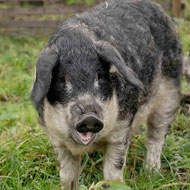
mangalitsa pig
Usually, diggers would be used to remove the pine needles but pigs are more environmentally friendly.

Conservation charity employs a herd of pigs for habitat creation

A herd of rare breed pigs have been tasked with creating a perfect habitat for endangered species in Dorset.

For the first time, the Royal Society for the Protection of Birds (RSPB) has recruited six Mangalitsa pigs to restore its Arne nature reserve to natural heathland through grazing.

It is hoped the site will then become an ideal home for species such as the Dartford warbler, nightjar, smooth snake, sand lizard and stonechats.

"It is an experimental project that we hope will produce fantastic results for nature at our Arne reserve," said Mark Singleton, RSPB Dorset reserves operations manager.

Last year, the RSPB's State of Nature report found that 60 per cent of UK species have declined over the past five decades. Mr Singleton said the rare breed pig project is "one of many that the RSPB is carrying out to tackle this problem and try to reverse these declines."

In its current state, the land at Arne is covered in pine needles and bracken, up to six inches deep in places.

Ordinarily the charity says it would use diggers and other machines to carry out the work, but the pigs are a more environmentally friendly option.

Mangalitsas are the only pig species in England to grow distinctive hairy fleeces similar to sheep. As they get stuck into the six-month project, the rare breed pigs will be joined by six Berkshire pigs.

The pigs are not alone in helping the charity with its conservation projects. Konik ponies, for example, help to manage habitats and create a mosaic of different vegetation types at RSPB Minsmere.

"There are many benefits to conservation grazing," said David Burton, senior advisor at Natural England. "Grazing animals helped shape many of our semi-natural habitats, which developed rich and diverse wildlife communities."

Image © Nienetwiler, Wikipedia CC BY-SA 3.0

Become a member or log in to add this story to your CPD history

Vets launch new podcast for pet owners

News Story 1
 Two independent vets have launched a podcast to help owners strengthen their bond with pets. Dr Maggie Roberts and Dr Vanessa Howie, who have worked in both veterinary practice and major charities, are keen to use their experience to enable people to give pets a better life.

The venture, called Vets Talking Pets, provides advice and information on a range of topics, including how to select a suitable pet, where to obtain them and how to get the best out of your vet. Maggie and Vanessa will also discuss sensitive subjects, including end-of-life care, raw food diets and the cost of veterinary care.

The podcast can be found on all the usual podcast sites, including Podbean, Apple, Amazon Music and YouTube. 

Click here for more...
News Shorts
VMD issues guidance on AVM-GSL packaging

The Veterinary Medicines Directorate (VMD) has shared advice on its requirements for medicines considered AVM-GSL.

The guidance explains the information that should be on the outer package, and sets out the typical maximum pack size for an AVM-GSL product. It also describes the user-friendly language, structure and phrases required on packaging and product leaflets.

AVM-GSL products do not require discussion between the purchaser and a veterinary professional. This means that clear product information is needed to support sales choices.

The information will be useful for submitting new products to the AVM-GSL category and lowering the distribution category of products from NFA-VPS to AVM-GSL.

The VMD's guidance can be accessed here.


