


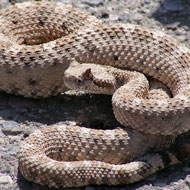
Sandy slope climbing findings have implications for biologists and roboticists
A new study has shown how sidewinder snakes quickly climb sandy slopes - a discovery that may have practical implications for the development of robotics.
The ability of the snakes to quickly climb shifting sands was once something biologists only vaguely understood and roboticists only dreamed of replicating but by studying the snakes in a unique bed of inclined sand, and using a snake-like robot to test ideas spawned by observing the animals, both groups of scientists have now gained useful insights.
In a study published in the journal Science, researchers from the Georgia Institute of Technology, Carnegie Mellon University, Oregon State University and Zoo Atlanta report that sidewinders simply increase the amount of their body area in contact with the granular surfaces they’re climbing.
As part of the study, the principles used by the sidewinders to gracefully climb sand dunes were tested using a modular snake robot developed at Carnegie Mellon.
Before the study, the snake robot could use one component of sidewinding motion to move across level ground, but was unable to climb the inclined sand. However, when the robot was programmed with the wave motion discovered in the sidewinders, it was able to climb sandy slopes.
Daniel Goldman, an associate professor in Georgia Tech’s School of Physics, said; “Our initial idea was to use the robot as a physical model to learn what the snakes experienced. By studying the animal and the physical model simultaneously, we learned important general principles that allowed us to not only understand the animal, but also to improve the robot.”
The motion of the snakes was recorded using high-speed video cameras which helped the researchers understand how the animals were moving their bodies. Limbless animals like snakes can readily move through a broad range of surfaces, making them attractive to robot designers.
Joe Mendelson, director of research at Zoo Atlanta, said while many people dislike snakes they are one of the most versatile of all land animals and are easy study subjects who have provided knowledge that may benefit humans.
“If a robot gets stuck in the sand, that’s a problem, especially if that sand happens to be on another planet. Sidewinders never get stuck in the sand, so they are helping us create robots that can avoid getting stuck."
The modular snake robot used in this study was specifically designed to pass horizontal and vertical waves through its body to move in three-dimensional spaces.
The research was funded by the National Science Foundation, the Army Research Office, and the Army Research Laboratory and the robots may now be used for applications such as urban search-and-rescue operations, in which robots need to make their way through the rubble of collapsed structures, archaeological explorations and for inspecting nuclear power plants from the inside out.


 Defra has published guidance for the vet sector ahead of a proposed UK-EU Sanitary and Phytosanitary agreement.



