


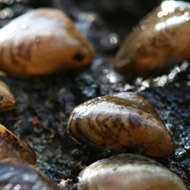
Freshwater species from south east europe have been found in Britain's waterways
Researchers from the University of Cambridge are warning that Britain is heading for an 'invasional meltdown' of freshwater species from south east Europe.
The most high-risk freshwater invaders are from the Ponto-Caspian region around Turkey and Ukraine. The quagga mussel, for example, was confirmed just two weeks ago in the Wraysbury River, close to Heathrow airport. Ten high-risk species have also been discovered just across the channel in Dutch ports.
In the study, published yesterday in the Journal of Applied Ecology, the authors describe Britain's need to confront the Ponto-Caspian problem - named for the invaders' homelands of the Black, Azov and Caspian seas - as a "vital element for national biosecurity."
The researchers say that monitoring efforts should be focused on areas most at risk of multiple invasions - for example, the lower reachers of the Rivers Great Ouse, Thames and Severn and the Broadlands, where ornamental plant trading and shipping ballast water is most likely to inadvertently deposit the cross-channel invaders.
All of these areas are projected to see an influx of up to 20 Ponto-Caspian invading species in the near future.
Dr David Aldridge, co-author of the study, said: "Pretty much everything in our rivers and lakes is directly or indirectly vulnerable. The invader we are most concerned about is the quagga mussel, which alarmingly was first discovered in the UK just two weeks ago. The pest will smother and kill our native mussels, block water pipes and foul boat hulls. We are also really worried about the Ponto-Caspian shrimps, which will eat our native shrimps."
Sarah Chare at the UK Environment Agency, said: "Invasive species - such as the quagga mussel - cost the UK economy in excess of £1.8 billion every year."
The quagga mussel is a highly invasive non-native species, affecting water quality and clogging up pipes. If you spot one, then please report it to us through the online recording form."
To read more about the research, visit http://www.cam.ac.uk/research/news/britain-on-brink-of-freshwater-species-invasion-from-south-east-europe
Image (C) University of Cambridge/David Aldridge.


 Defra has published guidance for the vet sector ahead of a proposed UK-EU Sanitary and Phytosanitary agreement.



