


Evolution of prehistoric crocodiles mirrored in modern species
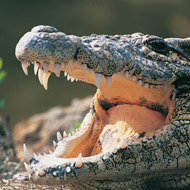
The development of the prehistoric crocodile mirrors those of today's crocodiles
New research by the University of Edinburgh has revealed that prehistoric crocodiles developed in a similar way to their modern day relatives.
The study looked into a group of prehistoric marine crocodiles known as Machimosaurus and reveals key details of where and how they lived.
Just like modern-day crocodiles, each species of Machimosaurus adapted features that enabled them to live and hunt in a range of habitats. They varied in body length, body skeleton, lower jaw and skull shape, and in their teeth.
The group included a nine-metre long saltwater species, which was adapted for living in open seas and fed on marine turtles. In contrast, its closest relative lived in choppy, coastal environments.
The development of the prehistoric crocodile mirrors those of today's crocodiles, whose saltwater varieties are much bigger and suited to large territories, whilst their smaller cousins live closer to shore or in freshwater.
From detailed analysis of fossil specimens, the research team were able to determine key elements of the animals' anatomy and lifestyle, and concluded that not all were of the same species.
Scientists were unsure whether more than one species of Machimosaurus existed until now. However, their findings reveal that there were at least three distinct species - one of which has been fully identified for the first time.
Dr. Mark Young, who led the study, said: "Interesting parallels can be seen between groups of ancient crocodiles and those living today, with some able to swim out in the open sea, with others restricted to the coast. With more fossils being discovered, we look forward to learning more about this giant group of Jurassic predators.”
The study is published in the journal Royal Society Open Science


 Defra has published guidance for the vet sector ahead of a proposed UK-EU Sanitary and Phytosanitary agreement.



