


Uncommon raven doing well after procedure at US centre
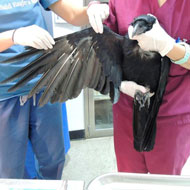
A common raven suffering severe feather loss is doing well after undergoing a transplant procedure. Vets decided to carry out the intricate process to help the uncommon patient fly again so it can be released back into the wild more quickly.
Vets at the Wildlife Center of Virginia say the bird has lost two of the feathers that were imped last month, but is flying well.
When it was admitted to the centre back in June the bird had lots of missing feathers, tattered flight feathers and dry, scabbed skin on the left thigh and under the left wing. Testing revealed a mite infestation to be the cause of the feather loss.
The raven, believed to be female, was found by a member of the public and is part of a nesting pair from Henrico County, Virginia.
After treating the condition with anti-parasitic and anti-inflammatory drugs, staff said the raven had grown several new feathers last month. However, it still had eight broken or tattered primary feathers, meaning it was unable to fly. To speed its recovery, vets decided to carry out the transplant using donor feathers from Avian Haven in Maine and the the Wildlife Rehabilitation Centre of Minnesota.
The procedure took about an hour. Vets transplanted six feathers on the right wing and one on the left. One feather shaft on the left wing was too damaged, however.
Feathers are not only essential for flight, but also for thermoregulation and protection from the elements. Staff at the centre will continue to ensure the feathers remain intact and assess flight ability before the raven is released back into the wild.
Despite its condition, the bird has been feisty and reactive to staff. Ravens are highly intelligent creatures and can become easily bored in captivity. Staff are providing enrichment for the bird almost daily and had to move it to a larger enclosure with jungle gym perches after it became increasingly destructive and tore down the drapes and sheets covering its enclosure.
Image courtesy of the Wildlife Center of Virginia


 Defra has published guidance for the vet sector ahead of a proposed UK-EU Sanitary and Phytosanitary agreement.



