


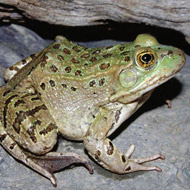
Years after naturalist's claim of a new species was rejected, frog named in his honour
Decades after claims that a new species of frog existed in New York and New Jersey were dismissed, a team of scientists have proven that the frog does in fact exist, and are naming it after the ecologist who first noticed it.
Rutgers doctoral candidate Jeremy Feinberg said: "Even though he was clearly on to something, the claim Carl Kauffeld made in his 1937 paper fell short. We had the benefits of genetic testing and bioacoustic analysis that simply weren't available to Kauffeld to prove that even though this frog might look like the two other leopard frogs in the area, it was actually a third and completely separate species."
In the paper, published in the scientific journal PLOS ONE, Feinberg and a team of seven other researchers revealed the scientific name for the new species: Rana kauffeldi. The leopard frog, originally found not far from the Statue of Liberty, will be commonly referred to as the Atlantic Coast Leopard Frog.
The paper provides the critical evidence needed to formally describe and name the new frog and also presents information on the distribution, ecology, and conservation status of this species.
There are now a total of 19 leopard frogs in the world. Scientists say the fact that this new species remained under the radar in a highly populated area is remarkable.
Feinberg's adviser said: “It is incredible and exciting that a new species of frog could be hiding in plain sight in New York City and existing from Connecticut to North Carolina. The process of recognising, identifying and documenting a new species is long and arduous but it is important for our understanding of the wide ranging wildlife in urban as well as other environments.”
Image (C) Graeme Bartlett


 Defra has published guidance for the vet sector ahead of a proposed UK-EU Sanitary and Phytosanitary agreement.



