
Your data on MRCVSonline
The nature of the services provided by Vision Media means that we might obtain certain information about you.
Please read our Data Protection and Privacy Policy for details.

In addition, (with your consent) some parts of our website may store a 'cookie' in your browser for the purposes of
functionality or performance monitoring.
Click here to manage your settings.
If you would like to forward this story on to a friend, simply fill in the form below and click send.

Your friend's email:
Your email:
Your name:
 
 
Send Cancel

Sentinel mongooses adjust decisions according to danger level
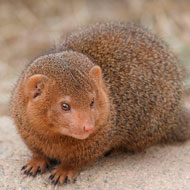
dwarf mongoose
Foraging mongooses rely on sentinels to alert them to approaching danger.

Bristol researchers find mongooses act similarly to human soldiers on sentry duty

Dwarf mongooses adapt their behaviour according to the level of danger in the same way as soldiers on sentry duty, new research has found.

A new study published in Animal Behaviour shows mongooses on "sentry duty" altered their behaviour depending on social signals, including alarm calls, and environmental conditions, such as wind speed.

Such factors influenced decisions about when they should go on duty, the positions they adopted and how long they remained at their post.

Julie Kern, lead author and PhD student at the University of Bristol, said: "Our work demonstrates how sentinel behaviour is adjusted flexibly with regard to information presented on various time scales, highlighting the complexity of animal decision-making processes".

The research team observed the behaviour of a population of individually marked, wild dwarf mongooses that were accustomed to the presence of observers close by.

Dwarf mongooses live in close family groups of five to 20 individuals. Nights are spent in a safe retreat and the animals emerge during the day to forage for insects and lizards. A wide range of predators pose a threat, including snakes, cats and birds of prey.

Foraging mongooses rely on sentinels to alert them to approaching danger, allowing them to adjust their own behaviour.

Image © Miika Silfverberg (MiikaS) from Vantaa, Finland/Wikimedia Commons/Creative Commons Attribution-Share Alike 2.0 Generic


Become a member or log in to add this story to your CPD history

Submissions open for BSAVA Clinical Research Abstracts 2026

News Story 1
 The BSAVA has opened submissions for the BSAVA Clinical Research Abstracts 2026.

It is an opportunity for applicants to present new research on any veterinary subject, such as the preliminary results of a study, discussion of a new technique or a description of an interesting case.

They must be based on high-quality clinical research conducted in industry, practice or academia, and summarised in 250 words.

Applications are welcome from vets, vet nurses, practice managers, and students.

Submissions are open until 6 March 2026. 

Click here for more...
News Shorts
Survey seeks ruminant sector views on antimicrobial stewardship

A new survey is seeking views of people working in the UK ruminant sector on how to tackle the challenge of demonstrating responsible antibiotic stewardship.

Forming part of a wider, collaborative initiative, the results will help identify the types of data available so that challenges with data collection can be better understood and addressed.

Anyone working in the UK farming sector, including vets and farmers,is encouraged to complete the survey, which is available at app.onlinesurveys.jisc.ac.uk

