


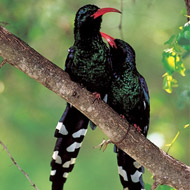
Green woodhoopoes unite at nightfall following a territorial conflict with their neighbours
New research by the University of Bristol has found that birds marshal their troops to defend key resources when threatened by rivals.
Biologists Dr Tim Fawcett and Dr Andy Radford discovered that groups of green woodhoopoes come together at nightfall following a territorial conflict with their neighbours. Such disputes prompt these African birds to spend the night together in the conflict zone, strengthening their defence.
The study reveals that clashes between rival groups have a long-lasting impact on behaviour of the birds.
Dr Radford said: "Our work provides evidence that between-group conflict can continue to affect within-group behaviour many hours after any initial stress has passed."
Dr Fawcett added: "The threat posed by rival groups creates a strong selective pressure to stick together in defence, just as tribal warfare likely promoted the evolution of cooperative human societies."
Territorial disputes increased the likelihood of a consensus between woodhoopoe groupmates over where to roost. Following a conflict, it was found that the birds also groom each other more, indicating tighter social bonding.
The woodhoopes showed even greater unity when they had lost a conflict, compared to when they had won.
Green woodhoopoes live in close-knit groups of up to 12. Each group roosts in a tree cavity, and uses one of those same holes for nesting. The scientists say that conflicts between groups "occur frequently and entail raucous vocal exchanges".
The paper, 'Conflict between groups promotes later defence of a critical resource in a cooperatively breeding bird', is published in Current Biology.
Image (C) Chris van Rooyen.


 Defra has published guidance for the vet sector ahead of a proposed UK-EU Sanitary and Phytosanitary agreement.



