
Your data on MRCVSonline
The nature of the services provided by Vision Media means that we might obtain certain information about you.
Please read our Data Protection and Privacy Policy for details.

In addition, (with your consent) some parts of our website may store a 'cookie' in your browser for the purposes of
functionality or performance monitoring.
Click here to manage your settings.
If you would like to forward this story on to a friend, simply fill in the form below and click send.

Your friend's email:
Your email:
Your name:
 
 
Send Cancel

New research explores how fossil tracks are formed
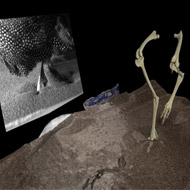
3D image
The 3D reconstruction of the bird’s leg and foot bones, as well as the footprints it left behind.

Information could be used to find out how bigger dinosaurs roamed the earth

Researchers from the Royal Veterinary College and Brown University are one step closer to unlocking the mysteries of fossilised footprints left by dinosaurs that walked the earth around 200 million years ago.

Dr Peter Falkingham, a research fellow in the RVC's Structure and Motion Lab, and co-author Professor Stephen Gatesy from Brown University, have, for the first time, been able to visualise the complex reorganisation of sedimentary particles during footprint formation.

The scientists imaged the subsurface foot movements of a chicken-like bird walking through soft sediment, and then used these movements to simulate the formation of a 3D, virtual footprint.

The simulation of the birds footprint was then compared to the fossilised track of a small dinosaur, similar in size to a small bird.

The work will help palaeontologists understand tracks left by dinosaurs on a deeper level.

Dr Falkingham said: “By observing how a footprint is formed, from the moment the foot hits the sediment until it leaves, we can directly associate motions with features left behind in the track. We can then study a fossil track left by a dinosaur and say ‘ok, these features of the track are similar, but these are different, so what does that mean for the way the animal was walking?’”

The virtual footprint was created by combining using a combination of 3D X-ray technology, animation and simulation.

The RVC say that going forward the research could be used to figure out how other, bigger dinosaurs roamed the earth, how prehistoric mammals migrated and even how early humans walked the land.

Image (C) Dr Peter L. Falkingham

Become a member or log in to add this story to your CPD history

Vets launch new podcast for pet owners

News Story 1
 Two independent vets have launched a podcast to help owners strengthen their bond with pets. Dr Maggie Roberts and Dr Vanessa Howie, who have worked in both veterinary practice and major charities, are keen to use their experience to enable people to give pets a better life.

The venture, called Vets Talking Pets, provides advice and information on a range of topics, including how to select a suitable pet, where to obtain them and how to get the best out of your vet. Maggie and Vanessa will also discuss sensitive subjects, including end-of-life care, raw food diets and the cost of veterinary care.

The podcast can be found on all the usual podcast sites, including Podbean, Apple, Amazon Music and YouTube. 

Click here for more...
News Shorts
VMD issues guidance on AVM-GSL packaging

The Veterinary Medicines Directorate (VMD) has shared advice on its requirements for medicines considered AVM-GSL.

The guidance explains the information that should be on the outer package, and sets out the typical maximum pack size for an AVM-GSL product. It also describes the user-friendly language, structure and phrases required on packaging and product leaflets.

AVM-GSL products do not require discussion between the purchaser and a veterinary professional. This means that clear product information is needed to support sales choices.

The information will be useful for submitting new products to the AVM-GSL category and lowering the distribution category of products from NFA-VPS to AVM-GSL.

The VMD's guidance can be accessed here.


