


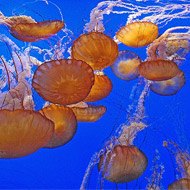
They can also swim strongly against them
Jellyfish can detect the direction of ocean currents and can swim strongly against them, according to research by Swansea University academics.
Professor Hays and Dr Sabrina Fossette tracked the movements of barrel-jellyfish with GPS loggers and GPS-tracked floats to record the flow of the current. They also directly observed the swimming direction of large numbers of jellyfish at the surface of the ocean.
The results revealed that jellyfish can actively swim at counter-current in response to drift. Their model of the jellyfishes’ behaviour and ocean currents helps to explain how jellyfish are able to form enormous blooms for periods up to several months.
The researchers say that it is not yet clear how the jellyfish figure out which way to go, but it is possible that they detect rent shear across their body surface, or that they may indirectly assess the direction of drift using other clues, such as infrasound or the Earth's magnetic field.
They add that having an understanding of the distribution of jellyfish in the open water may be useful for predicting and avoiding jellyfish blooms, especially if it turns out that the findings apply to other species. Although jellyfish play an important role in ocean ecosystems as prey for animals such as leatherback sea turtles, they can sting swimmers and clog fishing nets too.
Commenting on the research, Professor Hays said: “Now that we have shown this remarkable behaviour by one species, we need to see how broadly it applies to other species of jellyfish. This will allow improved management of jellyfish blooms.”
The paper, Fossette et al, Current-Orientated Swimming by Jellyfish and its Role in Bloom Maintenance, is published in Current Biology.
Image (C) Raggio5


 Defra has published guidance for the vet sector ahead of a proposed UK-EU Sanitary and Phytosanitary agreement.



