


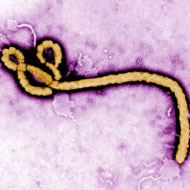
Scientists investigating whether disease could have become more contagious
Scientists tracking the ebola outbreak in Guinea warn that the virus has mutated, the BBC reports.
Experts at the Institut Pasteur in France, which first identified the outbreak last March, are investigating whether it could have become more contagious.
Through the analyses of hundreds of blood samples from Ebola patients in Guinea, the scientists hope to track how the virus is changing and establish whether if it is able to transmit more easily from one human being to another.
Speaking to the BBC, human geneticist Dr Anavaj Sakuntabhai said: "We know the virus is changing quite a lot, that's important for diagnosis (new cases) and for treatment. We need to know how the virus (is changing) to keep up with our enemy."
"We've now seen several cases that don't have any symptoms at all, asymptomatic cases," she said. "These people may be the people who can spread the virus better, but we still don't know that yet. A virus can change itself to less deadly, but more contagious and that's something we are afraid of."
Although mutations in viruses are common, researchers are worried that Ebola could eventually morph into an airborne disease if given enough time. However, there is no evidence to suggest that this is happening and the virus is still only spread through direct contact with another person.
Researchers at the Institut Pasteur are currently developing two vaccines which they hope will be in human trials by the end of the year.
Image (C) CDC Global/Wikimedia Commons/CC BY 2.0


 Defra has published guidance for the vet sector ahead of a proposed UK-EU Sanitary and Phytosanitary agreement.



