


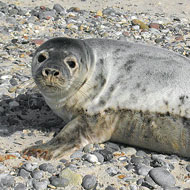
Research suggests cannibalism, not ship propellors, are behind injuries
New research showing cannibalistic grey seal behaviour suggests ship propellors may not be the main cause of 'corkscrew' seal deaths, as previously thought.
Researchers from the Seal Mammal Research Unit (SMRU) at St Andrews University observed an adult male grey seal killing five newly weaned seal pups, leaving them with the distinctive spiral injuries, often known as 'corkscrew' injuries.
From 2009-2014, 86 seal carcasses were found in Scotland with these injuries. Until recently it was thought they could be sustained from certain types of ship propellor. Marine Scotland commissioned the SMRU to examine the causes further.
While the preliminary findings do not completely eliminate ship propellors as a cause, they do suggest that such predatory behaviour in grey seals may be more common than previously thought.
The team tagged a number of grey seals in the Firth of Forth and one adult male was continuously monitored in daylight hours on the Isle of May from December 2-8, 2014. He was observed catching and killing five weaned pups.
In the same period, researchers collected another three pups with similar injuries from the same freshwater pool. They are believed to have been killed during the night and were not recorded on camera.
An additional six pups were also retrieved from tide pools and Kirkhaven beach (adjacent to the freshwater pools) between November 28 and December 9. Of these, four had similar spiral injuries and two had been killed by severe injuries to the skull, according to post-mortem examinations carried out by the marine mammal pathology team at the Scottish Marine Animal Strandings Sceme.
All eight carcasses found in the freshwater pools are believed to have been killed by the same adult male.
Researchers suggest a proportion of the corkscrew injuries seen in the UK may be due to grey seal predation.
Commenting on the findings, the Scottish environment secretary Richard Lochhead, said: "The clusters of 'corkscrew seal' deaths were unusual and worrying. In common with many of the creatures that live in our seas, seals are animals that are loved by the public.
"It is very important that we understand what caused these unusual deaths and we now have important evidence that natural predatory behaviour is likely to be the main cause, rather than ship propeller injuries as we first thought."
For the full report visit: http://www.smru.st-and.ac.uk/documents/2162.pdf
Image credit: Wikimedia Commons/CC BY 2.5/Andreas Trepte, www.photo-natur.de


 Defra has published guidance for the vet sector ahead of a proposed UK-EU Sanitary and Phytosanitary agreement.



