


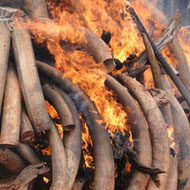
World Wildlife Day marks progress in the fight against poaching
In celebration of World Wildlife Day yesterday (March 3), conservationists marked the progress being made in the fight against elephant poaching and wildlife trafficking.
Kenya's president, Uhuru Kenyatta, burned 15 tonnes of ivory yesterday - a move which was praised by the Born Free Foundation's CEO Will Travers.
"Removing stockpiles, either by destruction or any means that prevents them from ever being traded, is a vital positive step and Kenya's courage is to be applauded," he said.
Kenya became the first country to destroy its ivory stockpile in 1989. Since then other countries have followed suit, including France, Belgium, China and Gabon.
Last week, the Chinese Government announced a one-year ban on ivory imports, which was welcomed by the Wildlife Conservation Society (WCS).
CEO Cristián Samper commented: "This action shows leadership by the world’s largest ivory consumer nation, and we hope to see additional and stronger action by officials in China on limiting the on-going demand of ivory in their nation."
Each year, it is estimated that poachers kill around 35,000 elephants to meet the global demand for ivory. China is the world's largest importer.
Poaching and the illegal ivory trade have spiralled out of control, reaching their highest level in 25 years and pushing elephant and rhino populations to the brink of extinction.
Malawi has also taken action this week with the completion of its ivory inventory and confirmation of its intention to destroy the ivory stockpile. Minister Hon Kondwani Nankhumwa also launched Malawi's 10 year national elephant action plan yesterday.
As part of the plan, the Department of National Parks and Wildlife in Malawi and UK charities Stop Ivory and the RSPCA will carry out a range of actions, including training park rangers, working with police and prosecutors to ensure the investigation and prosecution of poachers and wildlife traffickers and working with local communities to prevent human-elephant conflict.
Director of National Parks and Wildlife, Brighton Kumchedwa, said: "The ivory trade is driving the killing of our elephants. Armed criminal gangs pose a real and immediate threat to our rangers and the communities that live near protected areas. Malawi values its elephants, which are the bedrock of sustainable development through tourism."
In three weeks' time, international leaders are set to meet in Kasane, Botswana, to review the progress being made in tackling poaching and the illegal wildlife trade.
Image © Born Free Foundation


 Defra has published guidance for the vet sector ahead of a proposed UK-EU Sanitary and Phytosanitary agreement.



