


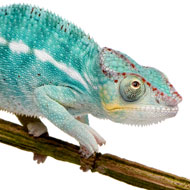
Vivid colour changes achieved through crystal rearrangement, study suggests
Scientists have shed new light on how chameleons are able to achieve their famous colour shifts.
It is now thought to be accomplished through the rearrangement of crystals inside specialised cells, rather that the dispersal of pigments.
Chameleons, particularly panther chameleons, are known for their ability to rapidly change between vivid colours in social situations - for example in contests between males or during courtship.
Previously, this was believed to be due to a gathering or dispersal of pigments in different cells. Quantum physicists and evolutionary biologists from the University of Geneva, however, now believe this is achieved by rearranging crystals in specialised skin cells called iridophores.
According to their findings, which have been published in the journal Nature Communications, a deeper layer of iridophores with larger crystals reflects a substantial amount of sunlight, which may help the reptiles to stay cool.
Senior author, Professor Michel Milinkovitch, told BBC News: "They split the iridophores into two layers, one that is specialised for colour change... and one to reduce the amount of energy absorbed by the animal.
"That's an amazing toolkit that allows them to choose between being hidden or displaying very spectacular colours for communication - and on top of that they have this ability to control their temperature because of the deep iridophores."
For the full study, visit: http://www.nature.com/ncomms/2015/150302/ncomms7368/full/ncomms7368.html


 Eligible members of BEVA will be able to vote for their Council team until Monday, 17 August 2026. Members will have received an election email on 17 July.



