


Bats obey traffic rules, study shows
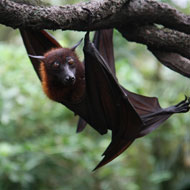
Bats abide by their own set of 'traffic rules': they chase each other, perform tandem turns and even slow down to avoid collision.
Bats hunting for food obey their own set of 'traffic rules', turning, chasing and avoiding collisions at high speed, according to a study by the University of Bristol.
Dr Marc Holderied from the School of Biological Sciences studied pairs of Daubenton's bats foraging low over water for stranded insects, at a site close to the village of Barrow Gurney in Somerset.
“Collective movements of flocking birds or shoaling fish are amongst the most fascinating natural phenomena, and everyone has experienced the challenges of walking through a moving crowd," said Marc. "What information individuals use for movement coordination is, however, very difficult to know – except in the case of echolocating bats.”
Because biosonar imaging in bats is much sparser in information than vision, Dr Holderied was able to accurately measure the biosonar calls of the interacting bats before calculating what each of the individuals perceived.
The results revealed that bats abide by their own set of 'traffic rules': they chase each other, perform tandem turns and even slow down to avoid collision.
The researchers discovered that bats use one simple trick to create their interactive behaviours - they swap leader-follower roles and perform chases by copying the route a nearby individual was using up to 500 milliseconds earlier - almost as fast as the blink of a human eye.
Dr Holderied said: “The bats seem to have adopted a simple trick: once another individual is close enough for your biosonar to pick up its echo, copy this individual’s flight direction within four to five of your own wingbeats.”
His research team believe the discovery could have wider implications, such as helping to improve the efficiency of search and rescue missions, and surveillance operations in the emerging market of flying drones and autonomous moving vehicles.
The study, ‘Delayed Response and Biosonar Perception Explain Movement Coordination in Trawling Bats’ by Luca Giuggioli, Thomas J. McKetterick and Marc Holderied, is published in PLOS Computation Biology.


 Defra has published guidance for the vet sector ahead of a proposed UK-EU Sanitary and Phytosanitary agreement.



