


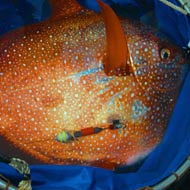
Opah flaps its fins to generate heat
Scientists have discovered the first fully warm-blooded fish - the opah. It heats its body by flapping its fins, giving it a competitive advantage in the cold ocean depths.
Fish that inhabit such cold depths are typically slow-moving and conserve energy by ambushing their prey rather than chasing it. Until recently, the opah was thought to be no different, but Californian scientists now say it is the only fish known to keep its whole body warmer than its environment.
This adaptation makes the opah a high-performance predator with improved muscle output and capacity and better eye and brain function. It allows it to migrate long distances, hunt down agile prey such as squid and resist the effects of cold on the heart and other organs.
“Nature has a way of surprising us with clever strategies where you least expect them," said lead author Nick Wegner. "It’s hard to stay warm when you’re surrounded by cold water but the opah has figured it out."
Mr Wegner, who works for the NOAA Fisheries Southwest Fisheries Science Centre, first noticed something unusual about opah when he studied a sample of its gill tissue. The blood vessels that carry warm blood to the fish's gills are wound around those that carry blood back to the body core after absorbing oxygen from the water.
In engineering, this design is known as 'counter-current heat exchange' and works in a similar way to a car radiator. For the fish, it means warm blood leaving the body's core heats the blood that returns from the respiratory surface of the gills.
As this heat exchange is located within the gills, it allows nearly the whole body of the fish to maintain its temperature. Some other fish including tuna and some shark species can keep certain parts of the body warm - for example the muscles to improve swimming performance - but their internal organs cool off quickly and slow down when they dive into cold waters.
"There has never been anything like this seen in a fish’s gills before,” Mr Wegner said. "This is a cool innovation by these animals that gives them a competitive edge. The concept of counter-current heat exchange was invented in fish long before we thought of it."
Data collected from opah caught in surveys off the West Coast showed their body temperature was often warmer than the surrounding water. On average, its muscle temperature was 5ºC above that of its environment, at depths of 150-1,300 feet below the surface.
Monitors attached to the fish showed their temperature remained steady when diving several hundred feet below the surface, even when the water temperature dropped sharply.
Image © NOAA Fisheries West Coast


 Defra has published guidance for the vet sector ahead of a proposed UK-EU Sanitary and Phytosanitary agreement.



