


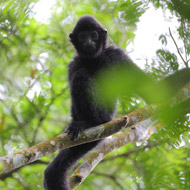
Threatened by habitat destruction, hunting and illegal trade
More than half of the world's primate species, including gibbons, lemurs and monkeys, are heading towards extinction, according to conservation experts.
The main threats are habitat destruction - particularly from the burning and clearing of tropical forests - as well as the hunting of primates for food, and the illegal wildlife trade.
New additions to the list of the world's 25 most endangered primates include the Philippine tarsier and the Lavasoa Mountains dwarf lemur.
The list also highlights the plight of the Hainan gibbon, of which there are just 25 remaining in the wild. Similarly, around just 50 northern sportive lemurs remain in their native Madagascar.
Updated every two years, the list has been put together by primatologists working in the field who have first-hand knowledge of the causes of threats to primates.
One of the editors of the report is Dr Christoph Schwitzer, director of conservation at Bristol Zoological Society and a world-leading primatologist.
Explaining the significance of the report, Dr Schwitzer said: “This research highlights the extent of the danger facing many of the world’s primates. We hope it will focus people’s attention on these lesser known primate species, some of which most people will probably have never heard of, such as the Lavasoa Mountains dwarf lemur from Madagascar - a species only discovered two years ago - or the Roloway monkey from Ghana and Ivory Coast, which we believe is on the very verge of extinction.”
He added: “Some of these animals have tiny populations remaining in the wild and support and action to help save them is vital if we are to avoid losing these wonderful animals forever.”
The report was compiled by Compiled by the Primate Specialist Group of IUCN’s Species Survival Commission, Bristol Zoological Society, the International Primatological Society, and Conservation International.
A link to the full report can be found at https://www.dropbox.com/sh/kkgo1ecgth7dmzp/AADQdd7qfgqHZqdmx8CSgKbLa?dl=0
Image (C) Zhao Chao


 Eligible members of BEVA will be able to vote for their Council team until Monday, 17 August 2026. Members will have received an election email on 17 July.



