


Disease affects around 17 million people worldwide
Researchers have taken a major step towards developing the world's first vaccine against river blindness.
Scientists at the University of Edinburgh say that a vaccination would end a 30 year quest to beat the disease, which affects around 17 million people across the globe.
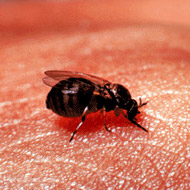
Over 90 per cent of cases of river blindness occur in west and central Africa. The disease is caused by infection with the parasitic worm Onchocerca volvulus and is spread by blackflies that breed in rivers.
Around 10 per cent of those infected go on to develop eye conditions, one per cent become blind, and 70 per cent develop very severe skin diseases which can lead to social exclusion.
Current control of river blindness relies on mass distribution of a drug called ivermectin, which has been successful in reducing incidence of the condition wherever it has been used. However, children under five - who comprise up to 20 per cent of the population in endemic regions - are excluded from the treatment.
Now, scientists from the University of Edinburgh's Division of Infection and Pathway Medicine have identified three potential vaccine compounds the could offer protection against the disease.
They hope to take at least one of these potential vaccines to safety trials, and to test its effectiveness by 2025. Eventually they hope to administer a vaccine to children as part of national immunisation programmes.
Commenting on the study, lead researcher professor David W Taylor, said: "New knowledge of the way nematode parasites regulate people's immune responses has guided formulation of experimental vaccines.
"A vaccine for river blindness would compliment and augment existing treatment and significantly improve the prospects for eliminating this disease from Africa."
The research initiative - The Onchocerciasis Vaccine for Africa (TOVA) - was launched in response to the London Declaration on Neglected Tropical Diseases which called for tools to eliminate river blinds from Africa.
TOVA builds on over 30 years of research by Academics from Edinburgh and researchers in Africa, Europe, and the US and involves 15 organisations across five countries.
Image (C) Wikimedia commons


 Defra has published guidance for the vet sector ahead of a proposed UK-EU Sanitary and Phytosanitary agreement.



