


Smartphone app could help to eradicate rabies
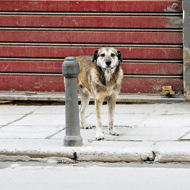
Rabies remains a global problem that leads to the suffering and premature deaths of over 50,000 people and many times more dogs each year.
A smartphone app could help to eradicate rabies from India, a new study has found.
Published in the journal BMC Infectious Disease, researchers are using the app to track free roaming dogs that have been vaccinated against rabies.
The method is allowing vets to vaccinate 70 per cent of the dog population in the city of Ranchi - the threshold needed to minimise the risk that the disease is passed to people.
Researchers hope that adopting the approach more widely, could help to eliminate rabies from people and animals.
The study was led by Mission Rabies in collaboration with researchers at the Royal (Dick) School of Veterinary Studies at the University of Edinburgh.
Commenting on the results, Dr Richard Mellanby, from the Royal (Dick) School, said: “We have shown that mobile technology can help to monitor the efforts of large scale vaccination of free roaming dogs in real time This allows us to identify areas where vaccination needs to be increased to meet the 70 per cent threshold and cut the risk of the disease being passed to people.”
In the study, researchers vaccinated over 6,000 dogs in 18 districts of Ranchi. They surveyed the number of marked, vaccinated and unmarked, unvaccinated dogs to monitor the proportion of animals that received the vaccine.
The researchers then uploaded information about the animals vaccinated, including their exact location, to the Mission Rabies smartphone app. In areas where the coverage fell below 70 per cent, catching teams were re-deployed to vaccinate more dogs until the target was achieved.
Rabies remains a global problem that leads to the suffering and premature deaths of over 50,000 people and many times more dogs each year.
The disease has been eliminated from many countries through mass vaccination of the dog population. However, elimination of the disease remains a challenge in countries where the majority of dogs are allowed to roam freely.
Previous research has show that vaccinating just 70 per cent of the dog population is enough to cut the risks of rabies infection in people.


 Defra has published guidance for the vet sector ahead of a proposed UK-EU Sanitary and Phytosanitary agreement.



