


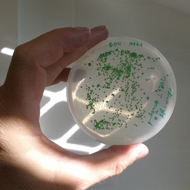
Scientists discover how cells can perceive light sources
Bacterial cells are able to 'see' the world around them, much like a tiny eyeball, scientists have discovered.
Previous research has shown that certain bacteria contain photosensors that allow them to perceive the position of a light source and move towards it. Until now it was not understood why, despite more than 300 years of research.
Scientists from the Queen Mary University of London have said the bacterial cell body acts like a lens. When light hits the spherical surface, it refracts into a point on the other side of the cell.
The bacteria then grow tiny 'tentacles' called pili in minutes. These reach out towards the light source and as they attach to the surface that they're on, they retract and pull the bacteria along.
Lead author Conrad Mullineaux commented: "The idea that bacteria can see their world in basically the same way we do is pretty exciting."
The research team studied synechocystis, a species of cyanobacteria that is found naturally in freshwater lakes and rivers. Cyanobacteria evolved about 2.7 billion years ago and the fact that they are able to photosynthesise is believed to have cause mass extinctions and the oldest known ice age.
As photosynthesis is key to the survival of this bacteria, scientists wanted to find out more about how they sense light.
"The fact that bacteria respond to light is one of the oldest scientific observations of their behaviour," Professor Mullineaux explained.
"Our observation that bacteria are optical objects is pretty obvious with hindsight, but we never thought of it until we saw it. And no-one else noticed it before either, despite the fact that scientists have been looking at bacteria under microscopes for the last 340 years."
Although synechocystis acts like a spherical lens, the research team believe rod-shaped bacteria could serve as an optical fibre, trapping light and sensing its location using refraction in a similar way.
Read the full paper here: http://elifesciences.org/content/5/e12620v1
Image © Conrad Mullineaux


 Defra has published guidance for the vet sector ahead of a proposed UK-EU Sanitary and Phytosanitary agreement.



