
Your data on MRCVSonline
The nature of the services provided by Vision Media means that we might obtain certain information about you.
Please read our Data Protection and Privacy Policy for details.

In addition, (with your consent) some parts of our website may store a 'cookie' in your browser for the purposes of
functionality or performance monitoring.
Click here to manage your settings.
If you would like to forward this story on to a friend, simply fill in the form below and click send.

Your friend's email:
Your email:
Your name:
 
 
Send Cancel

Zoonotic disease outbreaks in unlikely ‘hotspots’, study finds
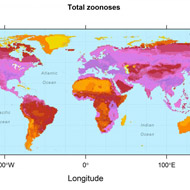
Map
Areas of high species diversity, such as the tropics, with a more zoonotic host species did not have correlating levels of zoonotic diseases.

New map shows patterns in zoonotic diseases

Research to assemble a map illustrating records of mammal-to-human disease outbreaks has revealed understudied patterns.

Researchers at the Carys Institute of Ecosystem Studies and the University of Georgia used data on all 27 orders of terrestrial mammals to track and record where outbreaks have and therefore are more likely to occur.

Previously believed to be inherently unpredictable, outbreaks of zoonoses appear to occur in unlikely hotspots. 

Disease ecologist and first author Barbara Han said: “I was rather surprised to see that hotspots of zoonotic diseases didn’t match hotspots of biodiversity more closely”.  

Areas of high species diversity, such as the tropics, with a more zoonotic host species did not have correlating levels of zoonotic diseases.

Han continued: “In contrast, more of the species living in the northern latitudes, such as the Arctic Circle, carry more zoonoses. Understanding the implications of this pattern in light of climate warming trends will be an important line of enquiry”.

Using information from the Global Infectious Disease and Epidemiology Network database and other sources, the map may help eventually to prepare for and predict further outbreaks of zoonoses and subsequent transmission to humans.

“Understanding where animals are distributed and why may not seem applicable to our day-to-day lives” Hans says, but the big breakthroughs that we need as a society rely exactly on this kind of basic scientific knowledge”.

Image (C) Drew Kramer

Become a member or log in to add this story to your CPD history

RCVS announces 1CPD app update

News Story 1
 The RCVS has announced a new version of its 1CPD mobile app, with enhanced features for veterinary surgeons and veterinary nurses to record their continuing professional development.

The mobile app includes a new 'what would you like to do?' shortcut for frequent tasks, a notification badge, and the ability to scan a QR code from the home screen to easily record an activity.

Users will be prompted to update the app from the App Store or Google Play the next time they log in. For more information, visit RCVS.org.uk 

Click here for more...
News Shorts
Survey seeks ruminant sector views on antimicrobial stewardship

A new survey is seeking views of people working in the UK ruminant sector on how to tackle the challenge of demonstrating responsible antibiotic stewardship.

Forming part of a wider, collaborative initiative, the results will help identify the types of data available so that challenges with data collection can be better understood and addressed.

Anyone working in the UK farming sector, including vets and farmers,is encouraged to complete the survey, which is available at app.onlinesurveys.jisc.ac.uk


