


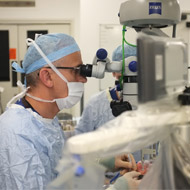
Procedure may be used to develop novel treatments for blindness
The world's first eye operation using a robot has been successfully completed at Oxford's John Radcliffe Hospital.
Surgeons remotely controlled the robot to lift a membrane 100th of a millimetre thick from the retina at the back of an eye.
Patient Dr William Bever is the first person to ever undergo the experimental procedure and said that his sight "is coming back".
Surgeons hope the procedure will eventually be used to develop novel treatments for blindness that are not possible with the human hand.
"There is no doubt in my mind that we have just witnessed a vision of eye surgery in the future," said Professor Robert MacLaren, who led the surgery.
The robot operates through a single hole in the eye that is less than 1mm in diameter. It is designed to eliminate unwanted tremors in the surgeon's hand - such as through their pulse - so tiny manipulations can be carried out safely.
Surgeons control the robot with a joystick and touchscreen outside the eye. This gives them a notable advantage as significant movements of the joystick result in tiny movements of the robot.
While robots have been developed for the large-scale surgery, this is the first time a device has been available that achieves the three dimensional precision required to operate inside the human eye.
"Current technology with laser scanners and microscopes allows us to monitor retinal diseases at the microscopic level, but the things we see are beyond the physiological limit of what the human hand can operate on," explains Professor MacLaren.
"With a robotic system, we open up a whole new chapter of eye operations that currently cannot be performed."
Speaking at his follow up visit at the Oxford Eye Hospital, Dr Beaver said: "My sight is coming back. I am delighted that my surgery went so well and I feel honoured to be part of this pioneering research project."
Professor MacLaren added: "This will help to develop novel surgical treatments for blindness, such as gene therapy and stem cells, which need to be inserted under the retina with a high degree of precision."
Image (C) Oxford University Hospitals


 Defra has published guidance for the vet sector ahead of a proposed UK-EU Sanitary and Phytosanitary agreement.



