


Response to concerns over primate brain studies
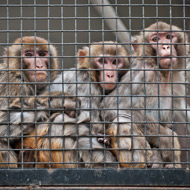
Scientists raised concerns about the level of suffering involved in many neuroscience experiments.
Over 400 scientists have signed a letter claiming that research on primates is crucial for tackling neurodegenerative and other crippling diseases such as Parkinson's.
The letter, published by the Guardian, follows recent calls to end support for primate brain studies that involve fluid deprivation and movement restraint.
A group of 21 experts including Dr Jane Goodall and Sir David Attenborough last week wrote an open letter to UK and EU bodies that are responsible for licensing and funding brain experiments on monkeys.
They raised concerns about the level of suffering involved in many neuroscience experiments, particularly those depriving animals of water and restraining their movement, and said there are now sufficient human-based alternatives to 'call into serious question whether further research of this type is necessary.'
But hundreds of scientists have responded by saying research on non-human primates has played a key part in life-changing medical advances - including treatments for leprosy, HIV and Parkinson's - and their 'careful and considered use' is necessary for the ongoing fight against crippling human diseases.
'The biological similarities between humans and other primates mean that they are sometimes the only effective model for complex neurodegenerative diseases such as Parkinson's,' they wrote.
The group acknowledged that such research requires greater ethical justification due to the intelligence and sensitivity of non-human primates, and said the scientific community works together to minimise suffering 'wherever possible'.
They added: 'Stringent regulations across the developed world exist to ensure that primates are only used where there is no other available model – be that the use of a mouse or a non-animal alternative – and to protect the wellbeing of those animals still required. The use of primates is not undertaken lightly.'
However Dr Jane Goodall, who has studied chimpanzees for over 50 years, believes it is "morally wrong" to confine our primate relatives to laboratory cages and subject them to experiments that are often painful and distressing. In addition, she said fluid deprivation and movement restraint is "inhumane and extremely cruel".


 Eligible members of BEVA will be able to vote for their Council team until Monday, 17 August 2026. Members will have received an election email on 17 July.



