


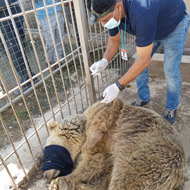
FOUR PAWS team are 'hopeful' the animals will recover
A rapid response team has arrived in Iraq to provide urgent veterinary care to the last remaining animals at Mosul zoo.
Mosul zoo was destroyed in the recent armed conflict between the Islamic State of Iraq and the Levant (ISIL). Most of the animals were killed or died of starvation, including a lioness, monkeys and rabbits.
On Tuesday morning (21 February), a FOUR PAWS rapid response team entered the city to find just two animals left - a lion and a bear. Both animals looked miserable and were suffering from malnutrition, bad teeth and an overall lack of veterinary care.
Led by vet Dr Amir Khalil, the FOUR PAWS team and local volunteers provided food, first aid, and cleaned their rubble-filled cages for the first time in months.
“The animals have desperately needed veterinary care and I didn’t believe that they would get it in time,” stated local volunteer Al Hakam Anas Zarari. “Under the circumstances, it would have been very optimistic to expect someone to come and help. I am very thankful to FOUR PAWS for their efforts.”
Dr Khalil added: “FOUR PAWS is the first animal welfare organisation to receive permission to enter the city of Mosul. We are happy that we managed to provide the bear and the lion with the urgently needed help.”
Mosul zoo was home to around 40 inhabitants before the conflict. The lion’s mother had died recently and was buried in a grave next to its cage. The bombings killed numerous animals and many tropical birds, monkeys and rabbits escaped. Some animals, including three bear cubs, were eaten by hungry predators or died of starvation.
Although the conflict has moved away from the zoo, the FOUR PAWS team still face huge risks. While performing a veterinary check they heard blasts of missiles in the remote part of the city.
“We managed to give the animals first aid and provide them with food but we had to leave the area before dark,” said Dr Khalil. “The risk is still too high – we even found some leaflets warning of upcoming terrorist attacks.”
The food and medicine provided by the team will be enough to last the next few weeks and will be distributed by local volunteers.
“The health condition of the animals is still far from good, but the care we’ve provided should help them to overcome the hardest time and we are hopeful they will recover,” concluded Dr Khalil.
Image (C) FOUR PAWS


 Eligible members of BEVA will be able to vote for their Council team until Monday, 17 August 2026. Members will have received an election email on 17 July.



