


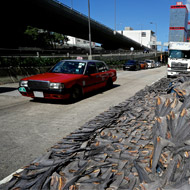
Traders falsely declaring fins as ‘fish products’
Huge volumes of shark fins are evading international shipping bans, despite transport lines making ‘No Shark Fin’ commitments, according to new research.
A three-month investigation carried out by Sea Shepherd Global documented large shipments arriving by carriers who have pledged to ban the transport of shark fin. This included two 45-foot containers full of shark fins from the Middle East which arrived in Maersk containers.
Sea Shepherd Global says that shark fin traders are abusing the system by fraudulently mis-declaring and mis-labelling shark fin under generic categories such as ‘seafood’, ‘dried seafood’, ‘dried goods’ or ‘dried marine products’ to avoid detection.
One airfreight shipment on Virgin Australia Cargo and Cathay Pacific which had been falsely declared as ‘fish products’ was not detected by customs. The exporter, who attempted to transport these goods, has now been blacklisted by Virgin Australia Cargo, which has a ban on the transportation of cargo fins.
“It's so sad what the team at Sea Shepherd has managed to discover,” commented Richard Branson, founder of Virgin Group. “Thousands and thousands of sharks slaughtered just for their fins to be turned into bowls of soup.
“For those people who have knowingly participated, they need to hang their heads in shame. For Sea Shepherd and the team led by Gary Stokes, they need to be congratulated for exposing this foul, and sometimes illegal trade.”
Alex Hoffard of WildAid added: ”Well over thirty airlines and just under twenty container shipping lines now operate No Shark Fin cargo bans. Yet some airlines, such and Japan Airlines and All Nippon Airlines, are resisting industry best practice and are still propping up the crime-ridden shark fin trade.
“WildAid is calling on all passenger airlines, cargo airlines, container shipping lines as well as express parcel carriers such as FedEx and TNT, to act sustainably, ethically – and above all legally – by ruling out dirty shark fin shipments from their cargo holds." said Alex Hofford, of WildAid.
In light of the investigation, Cathay Pacific, Maersk and Virgin and now working in collaboration with Sea Shepherd Global and WildAid to close all remaining loopholes being exploited by the shark fin trade.
“A full review is being undertaken of their booking procedures and alert mechanisms to help them enforce their bans,” said Gary Stokes Sea Shepherd Global’s SE Asia director.
Image (C) Gary Stokes/Sea Shepherd Global


 Eligible members of BEVA will be able to vote for their Council team until Monday, 17 August 2026. Members will have received an election email on 17 July.



