


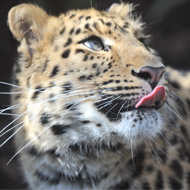
Facility will allow the cats to raise cubs away from humans
A new facility that will be home to two of the world’s rarest big cats has been unveiled at RZSS Highland Wildlife Park.
The facility, which encloses a large part of natural highland habitat, will accommodate a female and a male Amur leopard.
Keepers say that the enclosure will be off-show to visitors, to allow the cats to produce and rear cubs that are not familiar with humans. As such, this would make the cubs suitable for the Russian reintroduction project.
“If our leopard produce and rear cubs this year, we could be in a position to return cats to Russia by mid to late 2018, which is very exciting as our approach will dramatically abbreviate the reintroduction process,” commented Douglas Richardson, head of living collections at the park.
“Our Amur leopards will never be on show to our visitors but we hope to create an information hub that will explain all about this exciting conservation project and hopefully educate people about the plight of these animals.”
Focussing on cold weather species, RZSS highland Wildlife Park has had notable breeding success with an array of threatened carnivores. The introduction of male Freddo from Estonia and female Arina, born at Twycross Zoo, intends to build on that success.
Listed as Critically Endangered on the IUCN Red List, Amur leopards had been illegally hunted for their coat and other body parts for the trade in traditional medicine.
The releases are due to take place in the Lazovsky Nature Reserve in Southern Sikhote Alin, an area that is now completely devoid of leopards. It is not understood what caused extinction in this area, but experts say that circumstances have improved and there has been an increase in prey.
With improved conservation, organisers behind the Russian reintroduction project expect to see an increase in the present population in the wild from 70 animals to approximately 90 animals in 15-20 years.
Image (C) RZSS Highland Wildlife Park.


 Eligible members of BEVA will be able to vote for their Council team until Monday, 17 August 2026. Members will have received an election email on 17 July.



