
Your data on MRCVSonline
The nature of the services provided by Vision Media means that we might obtain certain information about you.
Please read our Data Protection and Privacy Policy for details.

In addition, (with your consent) some parts of our website may store a 'cookie' in your browser for the purposes of
functionality or performance monitoring.
Click here to manage your settings.
If you would like to forward this story on to a friend, simply fill in the form below and click send.

Your friend's email:
Your email:
Your name:
 
 
Send Cancel

Maps launched to tackle raptor persecution
“Birds of prey are a vital part of our animal landscape, icons of our cultural heritage and key to boosting local economies by attracting visitors to England and Wales."
Over 250 incidents reported in five years - Defra

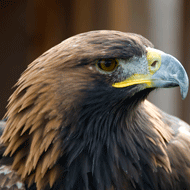
New online maps showing raptor persecutions in England and Wales have been published, to help police focus their efforts on areas with the highest level of incidents.

The maps, which will be updated annually, show the number of shootings, trappings, poisonings and nest destructions between 2011 and 2015.

They were developed by the Raptor Persecution Priority Delivery Group, which comprises government departments, police and the Crown Prosecution Service, as well as conservation charities and countryside organisations.

In the five-year period covered by the maps, there were 262 incidents, 146 of which were caused by shooting and 66 by poisoning.

North Yorkshire saw the largest number of incidents (39) and will therefore be a priority area, followed by Norfolk (17 incidents), Cumbria (11), Derbyshire (11), Lincolnshire (10), Suffolk (8) and Northumberland (8).

Wildlife Minister Thérèse Coffey said: “Birds of prey are a vital part of our animal landscape, icons of our cultural heritage and key to boosting local economies by attracting visitors to England and Wales.

“These maps highlight hotspots across the country for crimes against these precious birds, enabling the police to crack down with increased enforcement in areas where it’s needed most – building on the valuable work land management, conservation and shooting organisations are already doing to help protect iconic birds of prey.”


Become a member or log in to add this story to your CPD history

Equine Disease Surveillance report released for Q4 2025

News Story 1
 The latest Equine Disease Surveillance report has been released, with details on equine disease from Q4 of 2025.

The report, produced by Equine Infectious Disease Surveillance, includes advice on rule changes for equine influenza vaccination.

Statistics and maps detail recent outbreaks of equine herpes virus, equine influenza, equine strangles and equine grass sickness. A series of laboratory reports provides data on virology, bacteriology, parasitology and toxicosis.

This issue also features a case study of orthoflavivus-associated neurological disease in a horse in the UK. 

Click here for more...
News Shorts
RCVS annual renewal fee for vets due

RCVS' annual renewal fee for veterinary surgeons is now due. Vets must pay their renewal fee before Wednesday, 1 April 2026.

This year's standard annual fee has increased to 431 from last year's 418. This is an approximately three per cent increase, as approved by RCVS Council and the Privy Council.

Tshidi Gardner, RCVS treasurer, said: "The small fee increase will be used to help deliver both our everyday activities and our new ambitious Strategic Plan, which includes aims such as achieving new legislation, reviewing the Codes of Professional Conduct and supporting guidance, and continuing to support the professions through activities such as the Mind Matters Initiative, RCVS Academy and career development."

A full breakdown of the new fees is on the RCVS website. Information about tax relief is available on the UK government website.

