
Your data on MRCVSonline
The nature of the services provided by Vision Media means that we might obtain certain information about you.
Please read our Data Protection and Privacy Policy for details.

In addition, (with your consent) some parts of our website may store a 'cookie' in your browser for the purposes of
functionality or performance monitoring.
Click here to manage your settings.
If you would like to forward this story on to a friend, simply fill in the form below and click send.

Your friend's email:
Your email:
Your name:
 
 
Send Cancel

Clouded leopard escaped from private property
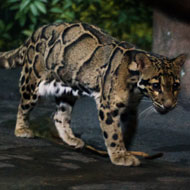
A clouded leopard, similar to the one pictured, went missing from a property in Cornwall.

Animal has been recaptured but is alleged to have killed sheep

A clouded leopard escaped from a private property in Cornwall, it has emerged, after unexpected flooding affected the security of the site.

The animal has since been recaptured but is alleged to have killed some sheep on a local farm.

Devon and Cornwall Police said they were informed by the leopard’s owner that it had escaped its inner compound on Boxing Day.

A spokesperson said: “The leopard was still in its outer compound and efforts were being made by the owner to re-capture the animal. Officers were then informed by a local farmer that the leopard had broken out of its compound and had allegedly attacked some of his sheep. The animal was re-captured.”

According to the local council, the leopard’s owner has an appropriate dangerous wild animal license.

A statement from Cornwall Council reads: ‘A full audit of the premises and licence has been undertaken and the circumstances surrounding the escape fully investigated.


‘The incident occurred due to an unforeseeable severe weather event causing a flood in an area not known to be subject to flooding. The owner has taken appropriate measures to prevent possible future flooding events from affecting the security of the site.’

Clouded leopards are listed as ‘vulnerable’ on the IUCN Red List of Threatened Species. It is found across South East Asia and the Himalayas. Whilst the exact population number is unknown, the species is thought to be in decline due to habitat loss and poaching.

Image by Charles Barilleaux/Wikimedia Commons/CC BY 2.0

Become a member or log in to add this story to your CPD history

Equine Disease Surveillance report released for Q4 2025

News Story 1
 The latest Equine Disease Surveillance report has been released, with details on equine disease from Q4 of 2025.

The report, produced by Equine Infectious Disease Surveillance, includes advice on rule changes for equine influenza vaccination.

Statistics and maps detail recent outbreaks of equine herpes virus, equine influenza, equine strangles and equine grass sickness. A series of laboratory reports provides data on virology, bacteriology, parasitology and toxicosis.

This issue also features a case study of orthoflavivus-associated neurological disease in a horse in the UK. 

Click here for more...
News Shorts
RCVS annual renewal fee for vets due

RCVS' annual renewal fee for veterinary surgeons is now due. Vets must pay their renewal fee before Wednesday, 1 April 2026.

This year's standard annual fee has increased to 431 from last year's 418. This is an approximately three per cent increase, as approved by RCVS Council and the Privy Council.

Tshidi Gardner, RCVS treasurer, said: "The small fee increase will be used to help deliver both our everyday activities and our new ambitious Strategic Plan, which includes aims such as achieving new legislation, reviewing the Codes of Professional Conduct and supporting guidance, and continuing to support the professions through activities such as the Mind Matters Initiative, RCVS Academy and career development."

A full breakdown of the new fees is on the RCVS website. Information about tax relief is available on the UK government website.


