


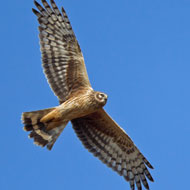
Natural England has issued a licence for a trial conservation scheme for hen harriers, which allows their eggs and/or chicks to be moved to a dedicated hatching and rearing facility.
Chicks will be reared in captivity, then transferred to specially-made pens in hen harrier breeding habitat, before being reintroduced to the wild in the uplands of northern England.
This intervention is permitted where hen harrier nests have reached an agreed density, with the permission of the landowner.
The licence covers a two-year period and comes with ‘stringent conditions’, according to Natural England, which is the government’s adviser on the natural environment in England.
Brood management forms part of Defra’s Hen Harrier Recovery plan. It aims to reduce hen harrier predation of grouse chicks on driven grouse moors, to improve the raptor’s conservation status.
However, the RSPB criticised the scheme, saying brood management is ‘about facilitating unsustainable intensive land management which is destroying our uplands’.
Natural England said it had scrutinised the licence application closely and will work with the licence applicant to ensure that all elements are carried out proportionately and effectively.
Chairman Andrew Sells commented: “Improving the conservation status of hen harriers across England is something I feel very passionate about. The principles of this trial have been carefully researched by those best-placed to understand the conflict which can occur between hen harriers and driven grouse moors.
“It is a complicated and emotive picture and we have considered this application very carefully. Licensing this trial will allow important evidence to be gathered which, I sincerely hope, will lead to a self-sustaining and well-dispersed breeding population of these beautiful birds across England.”
However, the move was criticised by the RSPB, who responded to the news on Twitter: ‘The idea that brood management is about helping hen harriers is a nonsense.
'It's about facilitating unsustainable intensive land management which is destroying our uplands. To be clear, RSPB are implacably opposed to this and as a landowner ourselves, will never allow it on our land.’
Illegal killing and disturbance is threatening to push hen harriers to extinction, RSPB has warned. Preying on red grouse brings them into conflict with intensive grouse rearing for shooting.
In 2013, they failed to breed successfully in England for the first time in nearly half a century and their numbers fells by 20 per cent in Scotland between 2004 and 2010.


 Eligible members of BEVA will be able to vote for their Council team until Monday, 17 August 2026. Members will have received an election email on 17 July.



