


Scientists urge governments to tackle hunting and deforestation
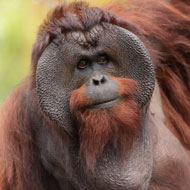
In the past 16 years, more than 100,000 Bornean orang-utans have been lost to poaching and deforestation, according to new research.
The international study, published in Current Biology, is the most comprehensive data coverage to date. Researchers from 38 institutions examined data from researchers on the ground, as well as aerial surveys and satellite images.
According to the findings, the most dramatic declines were seen in deforested areas, and areas that had been converted into agricultural land, most often for oil palm or paper pulp plantations.
However, the largest numbers of orang-utans were lost from areas where the forest remained intact, or where only the tallest trees had been selectively logged. Deaths in these areas were largely down to human pressures such as poaching, killing in conflict situations and collecting baby orang-utans for the pet trade.
Safer populations
On a positive note, scientists found there were more orang-utans on Borneo than previously thought, and some populations are relatively stable. These ‘safer populations’ in parts of Malaysian Borneo and larger national parks in Indonesian Borneo, mean it is unlikely that the species will go extinct in the near future.
In addition, research increasingly shows that orang-utans are more resilient and able to adapt to challenges than expected. For example, they can cover large distances by walking on the ground and feed on plants - such as acacia and oil palm - that are not part of their natural diet. It is thought this may allow them to survive in fragmented landscapes and much smaller forest patches than previously thought possible.
High rates of killing
What the species cannot cope with, however, is the high killing rates. Orang-utans are very slow breeders and research has shown a population could go extinct if only one reproductive female per 100 adults is removed each year. However, the killing rates are thought to be three or four times higher than this, which explains the immense losses seen in Borneo’s forests.
In the next 35 years, it is thought another 45,000 orang-utans could be lost due to habitat loss alone. Some 10,000 individuals currently live in areas that are allocated to oil palm development, but still forested. Researchers warned that, if these areas are converted, most of these orang-utans will die.
Hunting and collection for the pet trade must be tackled through public outreach, conflict resolution in local communities and law enforcement, according to the Max Planck Institute for Evolutionary Anthropology.
Meanwhile, Liverpool John Moores University, which also took part in the research, said collaboration with governments is needed, as well as the support of local communities and companies that manage the land. Researchers urged the governments of Indonesia and Malaysia to develop firm strategies to tackle the killing of orang-utans.
Image by Eric Kilby/Wikimedia Commons CC BY-SA 2.0


 Eligible members of BEVA will be able to vote for their Council team until Monday, 17 August 2026. Members will have received an election email on 17 July.



