


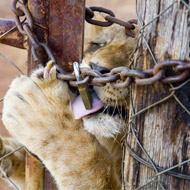
Born Free explores key role played by South African officials
The lion breeding industry in South Africa has grown year-on-year and has links to wildlife trafficking, according to a report published by the Born Free Foundation.
The report, Cash Before Conservation: An Overview of the Breeding of Lions for Hunting and Bone Trade, found that lions are facing an ‘unprecedented crisis’. It notes that habitat loss, falling prey numbers, unsustainable hunting practices, increased conflict with humans and increased demand for lion products are all taking their toll.
“As many as 8,000 lions languish in more than 200 captive breeding facilities across South Africa. These animals are cynically bred exclusively to generate money,” said Born Free’s president and co-founder, Will Travers. “Unwitting tourists fuel this despicable industry by participating in activities such as petting cubs and walking with lions, while unsuspecting volunteers rear cubs in the mistaken belief they are destined to be released into the wild.
“Once adult, many of these animals are moved to ‘canned hunting’ facilities to be shot in enclosures by ‘sport hunters.’ Their bones are then sold into an international trade sanctioned by the South African government.”
According to a recent assessment by the International Union for the Conservation of Nature, as few as 20,000 wild lions now occupy just eight per cent of their historic range. In spite of this, South Africa declared almost 7,500 lion trophy exports in the decade to 2013, and in 2017 the government issued an export quota for 800 lion skeletons from lions bred in captivity,
Furthermore, in the last five years, South Africa has exported more than 200 live captive-bred tigers, and dozens of tiger trophies, bones, claws and skills, mostly to Asia and the Middle East.
In its report, Born Free documents the growth of this industry and the support it has received from senior politicians and officials in South Africa. It also highlights the links between the export of lion trophies and products from captive-bred lions and the trafficking of other wildlife products.
Born Free concludes that urgent action is needed to end the captive breeding of lions, canned hunting and the sale of lion bones and skeletons into international markets. The focus should be on protecting lions in the wild, it said.
Image (C) Pippa Hankinson


 Eligible members of BEVA will be able to vote for their Council team until Monday, 17 August 2026. Members will have received an election email on 17 July.



