
Your data on MRCVSonline
The nature of the services provided by Vision Media means that we might obtain certain information about you.
Please read our Data Protection and Privacy Policy for details.

In addition, (with your consent) some parts of our website may store a 'cookie' in your browser for the purposes of
functionality or performance monitoring.
Click here to manage your settings.
If you would like to forward this story on to a friend, simply fill in the form below and click send.

Your friend's email:
Your email:
Your name:
 
 
Send Cancel

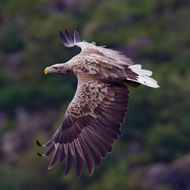
First sea eagle chick in Orkney for 140 years
RSPB staff believe there may be two chicks, judging by the behaviour of the parents.

RSPB believes first-time parents may have two chicks 

A white-tailed eagle chick has hatched in Orkney for the first time in over 140 years, RSPB Scotland has revealed.

One chick has been spotted but staff believe there may be two, judging by the behaviour of the parents.

White-tailed eagles, or sea eagles, reappeared in Orkney five years ago, after being wiped out in the UK in the early 20th century. A number of reintroduction programmes, beginning in the 70s, brought the species back to Scotland.

A pair has been sighted in Hoy every year since 2013 but nesting attempts were unsuccessful in 2015 and 2016.

Lee Shields, RSPB Scotland’s warden for Hoy, said: “It’s fantastic that the eggs laid in spring have hatched, the first successful breeding season here since the 19th century. This breeding attempt is still at the early stages, with young often in the nest for up to 14 weeks. Everybody was so excited when the first pair arrived and we’ve been keeping our fingers crossed for this ever since.

“We were hugely disappointed when a previous pair abandoned the territory last year, so to have at least one chick now is even more special.

“Even though they hadn’t nested here since 1873, white-tailed eagles have long been associated with Orkney’s natural and cultural heritage. Our RSPB Scotland reserve in Hoy is already home to hen harriers, great skuas, red-throated divers and more, so to see the eagles return backs up just how special this environment is.

“Now we’re just hoping that the chicks do well as it’s always uncertain with first-time parents.”


Image © Yathin S Krishnappa/CC BY-SA 3.0

Become a member or log in to add this story to your CPD history

Equine Disease Surveillance report released for Q4 2025

News Story 1
 The latest Equine Disease Surveillance report has been released, with details on equine disease from Q4 of 2025.

The report, produced by Equine Infectious Disease Surveillance, includes advice on rule changes for equine influenza vaccination.

Statistics and maps detail recent outbreaks of equine herpes virus, equine influenza, equine strangles and equine grass sickness. A series of laboratory reports provides data on virology, bacteriology, parasitology and toxicosis.

This issue also features a case study of orthoflavivus-associated neurological disease in a horse in the UK. 

Click here for more...
News Shorts
RCVS annual renewal fee for vets due

RCVS' annual renewal fee for veterinary surgeons is now due. Vets must pay their renewal fee before Wednesday, 1 April 2026.

This year's standard annual fee has increased to 431 from last year's 418. This is an approximately three per cent increase, as approved by RCVS Council and the Privy Council.

Tshidi Gardner, RCVS treasurer, said: "The small fee increase will be used to help deliver both our everyday activities and our new ambitious Strategic Plan, which includes aims such as achieving new legislation, reviewing the Codes of Professional Conduct and supporting guidance, and continuing to support the professions through activities such as the Mind Matters Initiative, RCVS Academy and career development."

A full breakdown of the new fees is on the RCVS website. Information about tax relief is available on the UK government website.

