


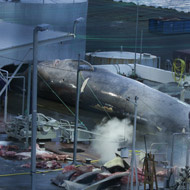
DNA analysis shows hunters didn't kill protected species
Researchers investigating the slaughter of a whale off the coast of Iceland have confirmed it was a rare hybrid of a fin and a blue whale.
Earlier this month, Sea Shepherd Global reported an endangered blue whale had been illegally killed by an Icelandic whaling company. But a press release issued by the Marine and Freshwater Research Institute (MFRI) said DNA results proved the whale was a hybrid.
“The results confirm that all the whales identified as hybrids are 1st generation hybrids where one of the parents is fin whale and the other parent a blue whale,” the press release read.
Kristján Loftsson’s commercial whaling company Hvalur hf is permitted by the Icelandic government to slaughter fin whales. However, it does not have a licence to kill endangered blue whales.
Photographs taken by marine conservation movement Sea Shepherd Global showed Loftsson's crew posing for photos next to the whale. The group said the whale had all the characteristics of a Blue Whale - a claim backed by experts, including Dr Phillip Clapham from the Alaska Fisheries Science Centre.
“While I can’t entirely rule out the possibility that this is a hybrid, I don’t see any characteristics that would suggest that,” he said. “From the photos, it has all the characteristics of a blue whale; given that - notably the colouration pattern - there is almost no possibility that an experienced observer would have misidentified it as anything else at sea.”
Following widespread public debate about the whale, researchers at the MFRI decided to conduct a genetic analysis to confirm its identity. They found it to be a hybrid of a fin whale mother and a fin whale father.
Under international regulations, it is the protected status of the hybrid parents that matter. So because the whale has a blue whale mother, the meat cannot be legally shipped anywhere.
According to BBC News, it is unlikely that the whalers will face any major repercussions.
Image (C) Sea Shepherd Global


 Eligible members of BEVA will be able to vote for their Council team until Monday, 17 August 2026. Members will have received an election email on 17 July.



