


Researchers propose rethink of ‘endangered species’ definition
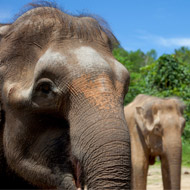
The researchers applied the ‘demographic safe space’ concept to the case of the Asian elephant.
A ‘demographic safe space’ for Asian elephants has been proposed by researchers at the Smithsonian Institute in a bid to improve their conservation.
According to new research, published to coincide with Endangered Species Day (17 May), conservation decisions based on population counts may fail to protect large, slow-breeding animals, like the Asian elephant, from decline.
Lead author Dr Shermin de Silva, president and founder of Asian elephant conservation charity Trunks & Leaves, said: “Critical thresholds in so-called vital rates – such as mortality and fertility rates among males and females of various ages – can signal an approaching population collapse long before numbers drop below a point of no return.
“We propose that conservation efforts for Asian elephants and other slow-breeding megafauna be aimed at maintaining their ‘demographic safe space': that is, the combination of key vital rates that supports a non-negative growth rate.”
The study, published in Frontiers in Ecology and Evolution, suggests that a combination of key vital rates governing population increase can better indicate a species’ viability than short-term trends in population size and distribution.
“History bears this out,” said Dr de Silva. “Genomic studies of the last mammoths isolated on Wrangel Island – between Russia and Alaska – have shown that although they were able to persist for thousands of years beyond the extinction of mainland populations with just 300 individuals, they had accumulated numerous genetic mutations that may have eventually contributed to their extinction.”
This means that populations of megafauna can become biologically inviable long before they disappear if pushed beyond their ‘demographic safe space.’
The researchers applied the ‘demographic safe space’ concept to the case of the Asian elephant and found that near-optimal reproduction and high calf survival is necessary to maintain non-negative population growth.
“Measures to enhance survival of calves, and particularly females, are key to saving the Asian elephant,” said de Silva. But while the attention of the world has been focused on the ivory trade, for critically endangered Asian elephant populations the greatest threat is habitat loss – followed by illegal trade in live animals and parts.
“Habitat loss can create something known as ‘extinction debt’ by slowing down birth rates and increasing mortality rates. For slow breeding long-lived species, even incremental changes make a big difference, but their longevity can obscure the risk of extinction.”


 Eligible members of BEVA will be able to vote for their Council team until Monday, 17 August 2026. Members will have received an election email on 17 July.



