
Your data on MRCVSonline
The nature of the services provided by Vision Media means that we might obtain certain information about you.
Please read our Data Protection and Privacy Policy for details.

In addition, (with your consent) some parts of our website may store a 'cookie' in your browser for the purposes of
functionality or performance monitoring.
Click here to manage your settings.
If you would like to forward this story on to a friend, simply fill in the form below and click send.

Your friend's email:
Your email:
Your name:
 
 
Send Cancel

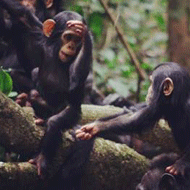
Chimps bond after watching films together - study
Chimpanzees who watch films together bond in a similar way to humans.

Bonding through shared experience may have deep evolutionary roots

Chimpanzees who watch films together bond in a similar way to humans, according to new research.

Until now, scientists believed that connecting with others was a uniquely human experience. But new research led by Duke University has revealed that apes are also able to create social closeness by participating in group activities.

In the study, chimpanzees, bonobos and humans were put into pairs and shown a short film. The film was of a young chimpanzee playing with its family - footage shown by previous research to capture the attention of great apes.

Each participant sat in a booth and looked through a screen towards a PC showing the video. An eye tracker was used to check the participants were watching the film while a tube filled with grape juice encouraged them to sit still. Once settled, the experimenter could enter the room.

After the film, the team measured how long the participants spent in each others proximity and the time engaged in interactive behaviours. They found that both chimpanzees and bonobos approached their partner faster after having watched a video with them.

'Our results suggest that one of the most basic mechanisms of human social bonding—feeling closer to those with whom we act or attend together—is present in both humans and great apes, and thus has deeper evolutionary roots than previously suspected,' the researchers conclude.

The study, Visually attending to a video together facilitates great ape social closeness, is published in Proceedings of the Royal Society B.


Become a member or log in to add this story to your CPD history

Vets launch new podcast for pet owners

News Story 1
 Two independent vets have launched a podcast to help owners strengthen their bond with pets. Dr Maggie Roberts and Dr Vanessa Howie, who have worked in both veterinary practice and major charities, are keen to use their experience to enable people to give pets a better life.

The venture, called Vets Talking Pets, provides advice and information on a range of topics, including how to select a suitable pet, where to obtain them and how to get the best out of your vet. Maggie and Vanessa will also discuss sensitive subjects, including end-of-life care, raw food diets and the cost of veterinary care.

The podcast can be found on all the usual podcast sites, including Podbean, Apple, Amazon Music and YouTube. 

Click here for more...
News Shorts
VMD issues guidance on AVM-GSL packaging

The Veterinary Medicines Directorate (VMD) has shared advice on its requirements for medicines considered AVM-GSL.

The guidance explains the information that should be on the outer package, and sets out the typical maximum pack size for an AVM-GSL product. It also describes the user-friendly language, structure and phrases required on packaging and product leaflets.

AVM-GSL products do not require discussion between the purchaser and a veterinary professional. This means that clear product information is needed to support sales choices.

The information will be useful for submitting new products to the AVM-GSL category and lowering the distribution category of products from NFA-VPS to AVM-GSL.

The VMD's guidance can be accessed here.

